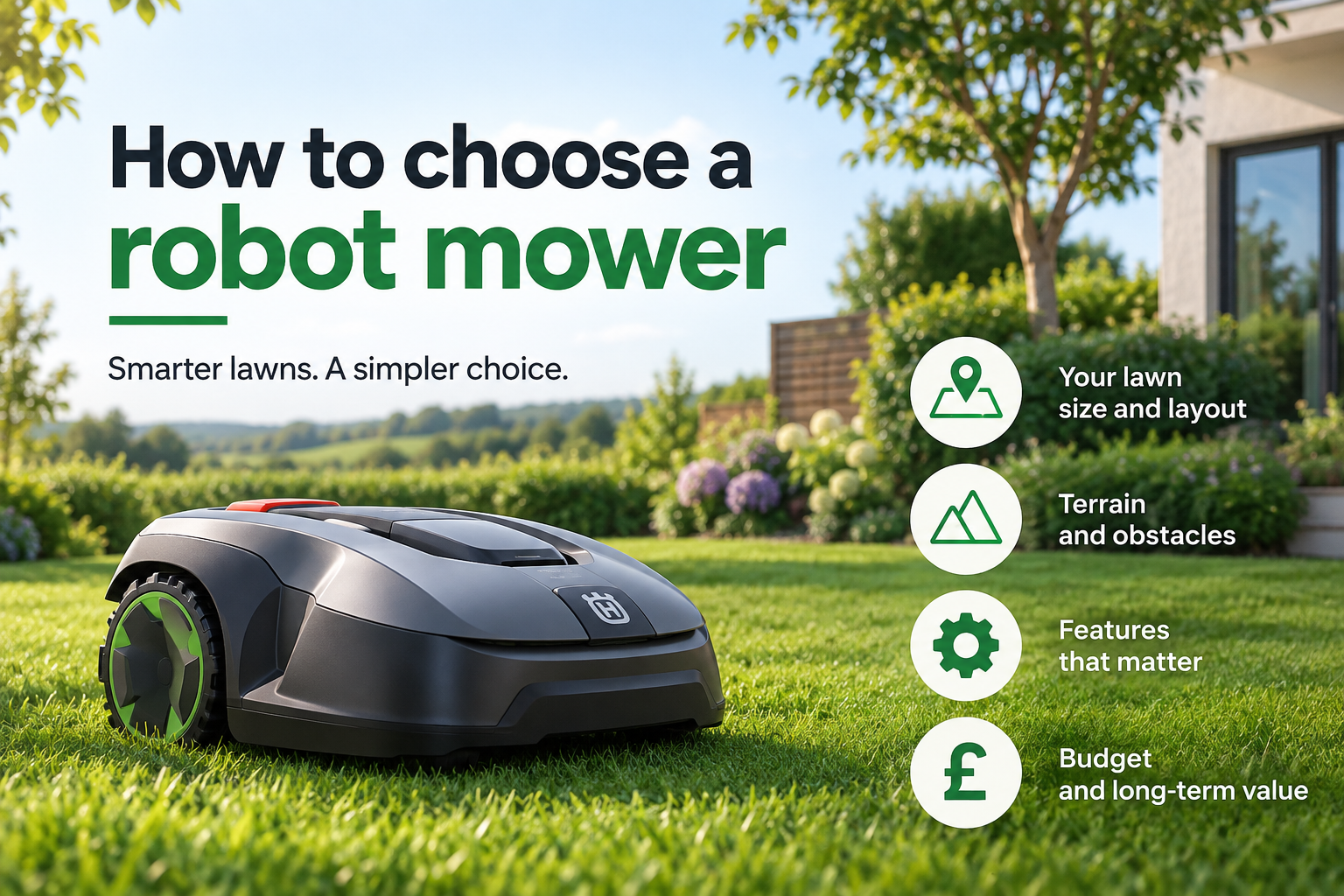
Choosing a robot mower can seem complicated at first. Lawn size, slopes, navigation systems, boundary wires and different specifications all affect which models are suitable for your garden.
The good news is that you don’t need to understand every technical feature before you start comparing.
Focus on your garden first. Once you know its size, layout and any difficult areas, it becomes much easier to narrow down the robot mowers that are likely to suit it.
The quick answer
Start with your garden, not the mower. Match your lawn size, steepest slope, garden layout and preferred navigation system first. Once you know which mowers can handle those requirements, compare features and price to find the best fit.
In this guide
- Lawn size
- Slopes
- Garden layout
- Boundary wire or wire-free
- Navigation technology
- Obstacles
- Battery and charging
- Features
- Installation
- Cost
1. Start with the size of your lawn
Lawn size is one of the most important things to check when choosing a robot mower.
Manufacturers usually give their mowers a recommended or maximum lawn area in square metres (m²). A mower designed for a small lawn may not have the battery capacity or mowing performance required for a much larger garden.
You therefore need a reasonable estimate of the area of grass you want the mower to maintain.
Don’t automatically choose a mower simply because its stated maximum area is just above the size of your lawn. Gardens with complicated layouts, slopes or separate lawn areas can place additional demands on a mower.
2. Check the steepest slopes
If your lawn isn’t completely flat, check the mower’s stated slope capability.
Robot mower specifications commonly express this as a percentage gradient. The important measurement is the steepest area the mower will actually need to travel across, rather than the average slope of the whole garden.
A garden with only one steep section can still require a mower with good climbing ability.
Also consider where the slope is located. Slopes close to lawn edges or boundaries can sometimes be more challenging than slopes in open areas.
3. Look at the layout of your garden
Two gardens of the same size can require very different robot mowers.
Look for features such as:
- Narrow passages
- Separate lawn areas
- Trees and other obstacles
- Uneven ground
- Complex lawn shapes
- Paths between mowing areas
A simple rectangular lawn is generally easier to navigate than a garden divided into several areas.
If your garden is complicated, navigation technology becomes particularly important.
4. Decide between boundary wire and wire-free navigation
One of the biggest decisions is whether you want a traditional boundary-wire mower or a wire-free model.
Boundary-wire robot mowers
These use a physical wire installed around the mowing area. The mower detects the wire and uses it to stay within the lawn.
Boundary-wire systems are well established, but installation takes time and changes to the lawn boundary may require the wire to be repositioned.
Wire-free robot mowers
Wire-free models can use technologies such as satellite positioning, RTK, cameras and other sensors to determine where they should mow.
They remove the need to install a physical perimeter wire and can make changing mowing areas easier.
However, wire-free does not automatically mean that every model will work equally well in every garden. Trees, buildings, narrow spaces and the mower’s particular navigation system can all influence suitability.
5. Compare navigation technology
Modern robot mowers can navigate in several different ways.
Depending on the model, you may encounter:
- Boundary-wire navigation
- GPS
- RTK satellite positioning
- Camera or vision-based navigation
- Sensors and obstacle detection
- Systems combining several technologies
Don’t choose a mower simply because one navigation technology sounds more advanced.
The better question is whether its navigation system suits the layout and conditions of your garden.
Ready to compare robot mowers?
Compare models by lawn size, slope capability, navigation technology, features and price to narrow down the options that suit your garden.
6. Check how the mower handles obstacles
Gardens rarely contain grass and nothing else.
Trees, flower beds, garden furniture, toys and other objects can all affect mowing.
Some robot mowers use cameras, ultrasonic sensors or other detection systems to recognise and avoid obstacles. The capabilities vary between models, so compare what each mower can detect rather than assuming all obstacle-avoidance systems work in the same way.
A garden containing lots of obstacles may benefit more from sophisticated detection than a simple open lawn.
7. Consider battery life and charging
Robot mowers normally return to a charging station automatically when their battery is running low.
For most owners, the headline battery runtime is therefore less important than whether the complete mowing and charging system is suitable for the lawn size.
For larger gardens, however, charging speed, battery capacity and mowing efficiency can become more important.
8. Look at useful features — not just the longest feature list
Robot mower specifications can contain a long list of features.
Depending on the model, these may include app control, mowing schedules, weather-related functions, adjustable cutting heights, theft protection, GPS tracking, obstacle detection and smart-home integration.
Prioritise the features that will genuinely make a difference in your garden.
A sophisticated feature you never use shouldn’t outweigh better lawn capacity, navigation or slope performance.
9. Think about installation
Installation requirements vary considerably.
A boundary-wire mower may require a perimeter wire to be installed around the lawn and potentially around excluded areas.
Wire-free systems avoid this physical boundary, but they can have their own setup requirements. Some may require a reference station or suitable positioning of other equipment.
Check what is required before buying rather than assuming every robot mower can simply be placed on the lawn and switched on.
10. Compare the total cost
The purchase price is important, but it isn’t the only cost to consider.
Depending on the mower, there may also be costs associated with replacement blades, installation equipment, accessories, servicing or replacement parts.
Compare the mower’s features and suitability alongside its price rather than choosing purely on the cheapest initial cost.
Which robot mower is right for your garden?
There isn’t one robot mower that is automatically best for every garden.
The right choice depends on the combination of:
- Lawn size
- Maximum slope
- Garden layout
- Narrow passages and separate areas
- Navigation technology
- Installation preference
- Features
- Budget
Start with those requirements and eliminate unsuitable models before comparing the remaining options in more detail.
That makes the process much simpler — and reduces the risk of paying for a mower that isn’t well suited to your lawn.
What matters most
- Lawn size — Match the mower’s capacity to the area you need to mow.
- Slopes — Check the steepest part of your lawn against the mower’s stated capability.
- Garden layout — Consider narrow passages, separate areas and obstacles.
- Navigation — Choose a system that suits your garden and installation preference.
- Budget — Compare suitability and useful features alongside the total cost.
Find the right robot mower for your garden
Compare robot mowers by lawn size, slope capability, navigation, features and price to find the models that best suit your garden.
Find my mower →