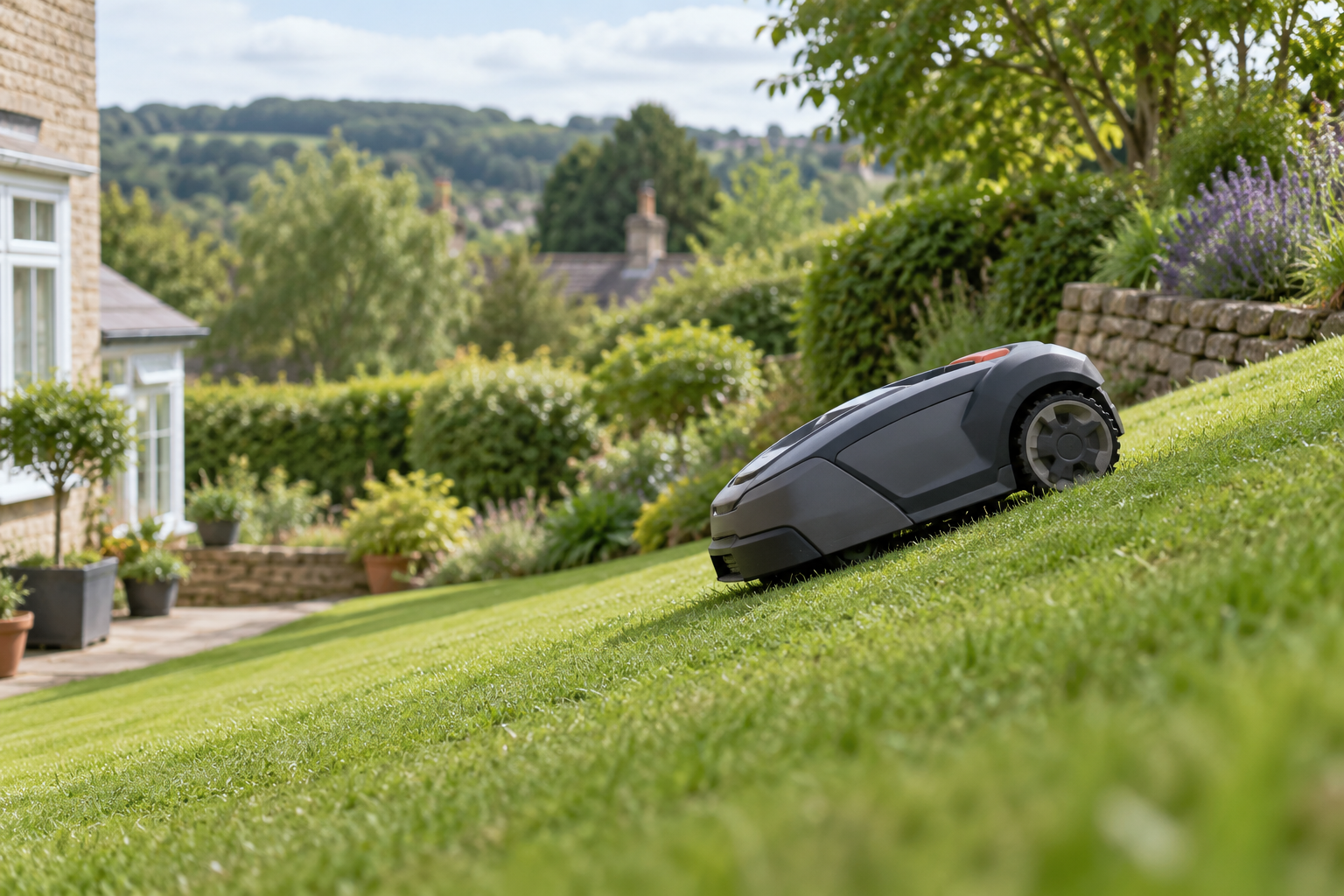
Slopes are one of the most important things to check when choosing a robot mower. A mower that works well on a flat lawn may struggle for traction or fail to operate safely on steeper ground.
Robot mower manufacturers usually state a maximum slope or gradient that their mower can handle, often as a percentage. Understanding what that figure means will help you compare models accurately.
Start by finding the steepest part of your lawn. You can then compare that gradient with each mower’s stated slope capability and leave a sensible margin rather than choosing a mower that will constantly operate at its maximum limit.
The quick answer
Check the steepest part of your lawn and compare it with the robot mower’s maximum stated slope capability. Avoid choosing a mower that only just meets your measurement — leaving some extra capacity can help when conditions are wet, uneven or slippery.
In this guide
- What robot mower slope ratings mean
- Percentage gradients explained
- How to measure your lawn’s slope
- Why maximum slope figures matter
- Traction and wet grass
- Uneven and rough ground
- Slopes near lawn boundaries
- Choosing a mower for a steep garden
1. What robot mower slope ratings mean
A robot mower’s slope rating tells you the steepest gradient the manufacturer states the mower can handle under its specified operating conditions.
Slope capability varies considerably between models. Factors such as the mower’s drive system, wheel design, weight distribution and traction can all affect how well it performs on an incline.
Treat the maximum figure as a limit rather than a target. If large parts of your lawn are steep, choosing a mower with some additional slope capability can give you a more suitable margin.
2. Percentage gradients explained
Robot mower slope capability is commonly shown as a percentage. This describes how much the ground rises vertically compared with the horizontal distance travelled.
For example, a 20% gradient means the ground rises 20 centimetres for every 100 centimetres of horizontal distance. A 40% gradient rises 40 centimetres over the same distance.
A percentage gradient is not the same as an angle in degrees. When comparing robot mowers, use the same measurement stated by the manufacturer to avoid comparing two different slope measurements.
3. How to measure your lawn’s slope
Measure the steepest part of your lawn rather than estimating the average slope across the whole garden.
One simple method is to measure a horizontal distance along the slope and then measure the vertical rise over that distance. Divide the vertical rise by the horizontal distance and multiply the result by 100 to calculate the gradient as a percentage.
For example, a rise of 30 centimetres over a horizontal distance of 100 centimetres is a 30% gradient.
Take measurements in several areas if your lawn has different inclines, and use the steepest relevant measurement when comparing robot mowers.
4. Why maximum slope figures matter
A manufacturer’s maximum slope figure tells you the upper limit the mower is designed to handle, but real garden conditions can make a slope more difficult.
Wet grass, loose soil, uneven ground and sharp changes in gradient can all reduce traction. A mower operating close to its maximum rating may therefore struggle in conditions that would not cause problems on a gentler incline.
If your lawn contains significant slopes, look for a mower with a maximum capability comfortably above the steepest gradient you have measured rather than relying on the limit alone.
5. Traction and wet grass
A robot mower needs enough traction to climb, turn and stop safely on sloping ground. Wheel design, drive system and weight distribution can therefore be particularly important in a steep garden.
Wet grass can make slopes more difficult because the mower’s wheels have less grip. Mud, fallen leaves and worn areas of lawn can also reduce traction.
If your garden is regularly damp or contains steep sections, consider the mower’s traction and terrain capabilities alongside its maximum slope rating.
Ready to compare robot mowers?
Compare robot mowers by maximum slope capability, lawn size, navigation, features and price to find models suitable for your garden.
6. Uneven and rough ground
A lawn can be difficult for a robot mower even when its overall gradient is within the manufacturer’s stated limit.
Bumps, dips, exposed roots, soft ground and sudden changes in slope can reduce traction or cause the mower to become stuck. These conditions can be especially challenging when combined with an incline.
If your lawn is both steep and uneven, look beyond the maximum slope figure and consider features such as wheel design, drive system and suitability for rough terrain.
7. Slopes near lawn boundaries
Slopes close to the edge of the lawn can be more challenging than slopes in the middle of the mowing area.
A mower may need space to turn or correct its direction near a boundary. Steep drops, retaining walls, ponds or other hazards around the edge of a lawn also require additional consideration.
Check the manufacturer’s guidance for maximum slopes at or near boundaries, as this may differ from the mower’s maximum slope capability elsewhere on the lawn.
8. Choosing a mower for a steep garden
Start with the steepest gradient you have measured and use it to rule out robot mowers that do not have sufficient slope capability.
For a steep garden, also compare traction, wheel design, drive system and suitability for uneven terrain. Some models are specifically designed to handle more demanding slopes and may be better suited to challenging gardens.
Avoid choosing purely on the highest advertised slope figure. The best mower is one that combines sufficient slope capability with the navigation, lawn capacity and features your garden requires.
What matters most
- Steepest slope — Measure the steepest relevant part of your lawn, not the average gradient.
- Safety margin — Choose a mower with slope capability above your measured requirement.
- Traction — Wet grass, mud and loose ground can make slopes more difficult.
- Terrain — Consider bumps, dips and uneven ground as well as the gradient itself.
- Boundaries — Check the manufacturer’s separate guidance for slopes near lawn edges.
Find a robot mower for your garden
Compare robot mowers by slope capability, lawn size, navigation, features and price to find models suited to your garden.