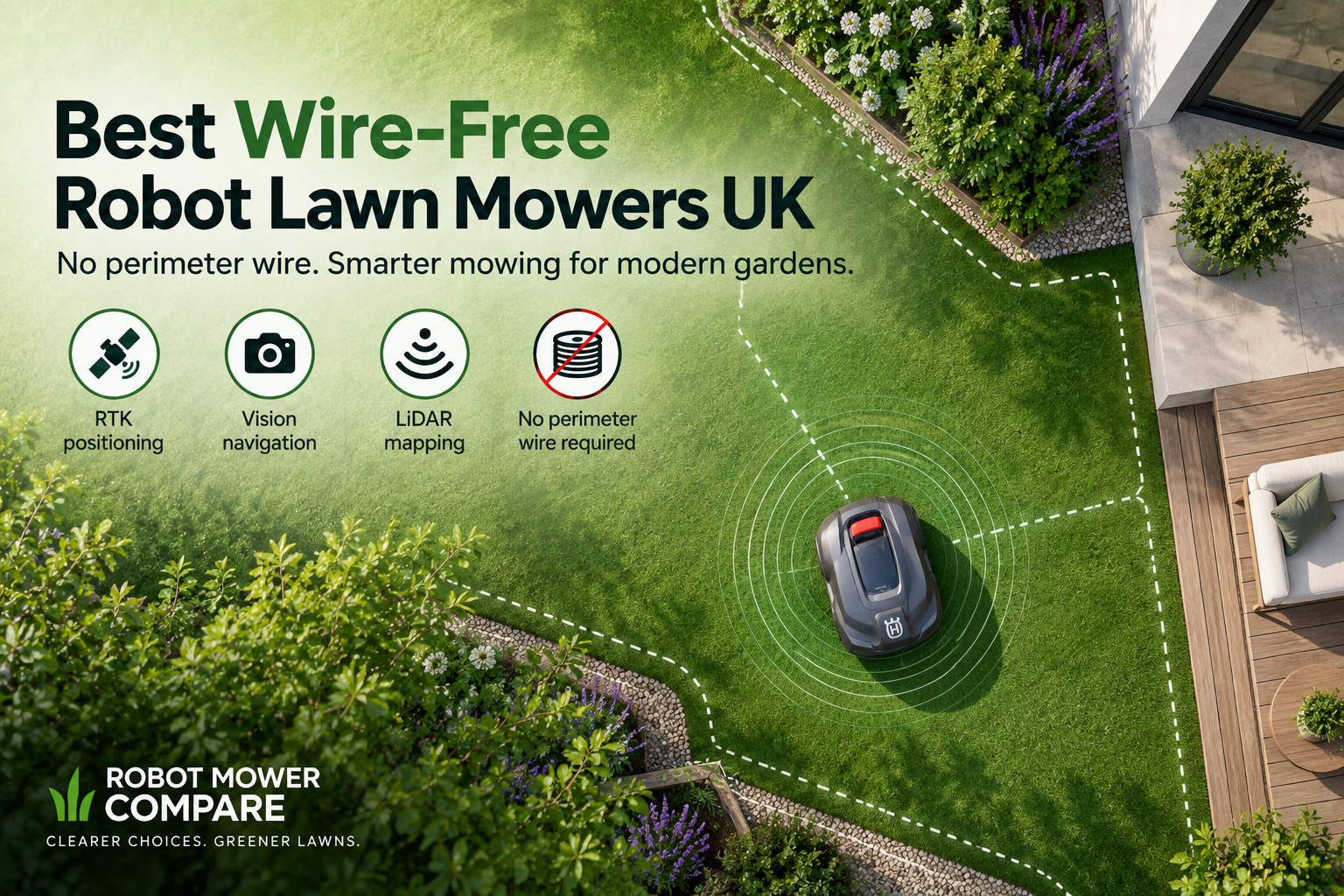
Wire-free robot lawn mowers remove the need for a traditional perimeter cable by using technologies such as satellite positioning, cameras and LiDAR to navigate the lawn. For UK gardens, that can mean a quicker installation and more flexible virtual mowing zones — but the different navigation systems are not all the same.
The quick answer
The best wire-free system depends on your garden rather than simply the mower with the highest specification. LiDAR and vision-based models can avoid a separate positioning antenna, while RTK systems can provide precise satellite positioning but some require additional hardware. Check lawn size, slopes, trees, buildings, separate lawn areas and navigation requirements before choosing.
In this guide
What is a wire-free robot lawn mower?
A traditional robot mower normally uses a physical boundary wire installed around the lawn. A wire-free mower instead establishes its mowing area electronically, allowing boundaries and mowing zones to be created without laying a perimeter cable.
Manufacturers achieve this in different ways. Current systems include RTK/GNSS satellite positioning, cameras and AI vision, LiDAR mapping and combinations of several technologies.
Wire-free does not necessarily mean hardware-free. Some satellite-positioning systems require an external antenna or reference station, while other models use network RTK, LiDAR or vision-based positioning without a separate garden antenna.
Wire-free robot mowers to compare
There are now many wire-free models in the Robot Mower Compare database. The examples below cover different garden sizes, navigation technologies and price points rather than treating one mower as the right choice for every garden.
ECOVACS GOAT O500 Panorama
The GOAT O500 Panorama combines LiDAR-enhanced panoramic vision and does not require an external positioning antenna. With a stated 500 m² lawn capacity, it represents one of the lower-priced routes into wire-free mowing in our current database.
Segway Navimow i205 AWD
The Navimow i205 AWD combines network RTK with vision-assisted navigation without requiring an external antenna. It is rated for lawns up to 500 m² and slopes up to 45%.
Mammotion YUKA mini 2 800
The YUKA mini 2 800 uses triple-camera AI vision with iNavi positioning and does not require an external antenna. Its stated maximum lawn area is 800 m².
Husqvarna Automower 308V
The Automower 308V combines satellite-based virtual boundaries with AI vision. Our current data records no external antenna requirement, with a stated lawn capacity of 800 m² and maximum slope of 40%.
Segway Navimow i210 LiDAR Pro
The i210 LiDAR Pro combines LiDAR, network RTK and vision navigation without a separate external antenna. It is rated for lawns up to 1,000 m² and slopes up to 55%.
Mammotion LUBA mini 2 AWD 1000
The LUBA mini 2 AWD 1000 combines tri-camera AI vision with NetRTK/iNavi positioning. Its AWD system is paired with a stated maximum slope capability of 80%, and our database records no external antenna requirement.
Mammotion LUBA 3 AWD 3000
For substantially larger lawns, the LUBA 3 AWD 3000 is rated for up to 3,000 m² and slopes up to 80%. It combines 360° LiDAR, NetRTK/iNavi and dual-camera AI vision without an external antenna requirement in our database.
Segway Navimow X430
The Navimow X430 is another large-garden option, combining Vision-LiDAR with network RTK. It is rated for lawns up to 3,000 m² and slopes up to 84%, with no external antenna requirement recorded in our database.
Prices, specifications and ratings were checked on 16 September 2026 and may change.
LiDAR, RTK or vision: which wire-free system should you choose?
LiDAR
LiDAR measures the mower’s surroundings using laser-based sensing and can form part of a navigation system that maps the garden without relying solely on satellite positioning. Several current models combine LiDAR with cameras or network positioning.
RTK and satellite positioning
RTK-based systems use satellite positioning with corrections to improve accuracy. Depending on the mower, those corrections may come through a dedicated reference station or through a network-based service.
Vision
Vision-based systems use cameras and software to understand the mower’s surroundings. Some models rely primarily on vision, while others combine cameras with RTK, LiDAR or other positioning technologies.
The technology name alone does not determine whether a mower will suit your garden. Trees, buildings, narrow passages, slopes and the complexity of the mowing area can all matter.
Do wire-free robot mowers need an external antenna?
No. Several current models in our database operate without a separate external positioning antenna, including LiDAR, vision and network-RTK models.
Others do require additional positioning hardware. For example, our current data records an external antenna requirement for the ECOVACS GOAT O600 RTK and Segway Navimow i105E.
Check the installation requirements of the specific model rather than assuming that “wire-free” means the same setup for every mower.
Choosing a wire-free mower for your garden
Start with the lawn rather than the navigation technology. Measure the mowing area, check the steepest slopes and consider trees, buildings, narrow passages, separate lawns and obstacles.
Then compare the mower’s stated lawn capacity and slope capability with the navigation method it uses. A sophisticated large-area mower may offer little advantage on a straightforward compact lawn, while a complex or steep garden may justify more advanced navigation and drive hardware.
Price also varies substantially. The wire-free models in our database span from several hundred pounds to well over £2,000, so it is worth identifying which capabilities your garden actually needs before comparing prices.
How we compare robot mowers
Robot Mower Compare uses product specifications and information checked primarily against manufacturer sources. Our ratings are editorial comparison ratings and should not be interpreted as hands-on testing unless we specifically state that a product has been personally tested.
Find the right robot mower for your garden
Use your lawn size, slopes and priorities to narrow down suitable models, or compare robot mowers side by side.