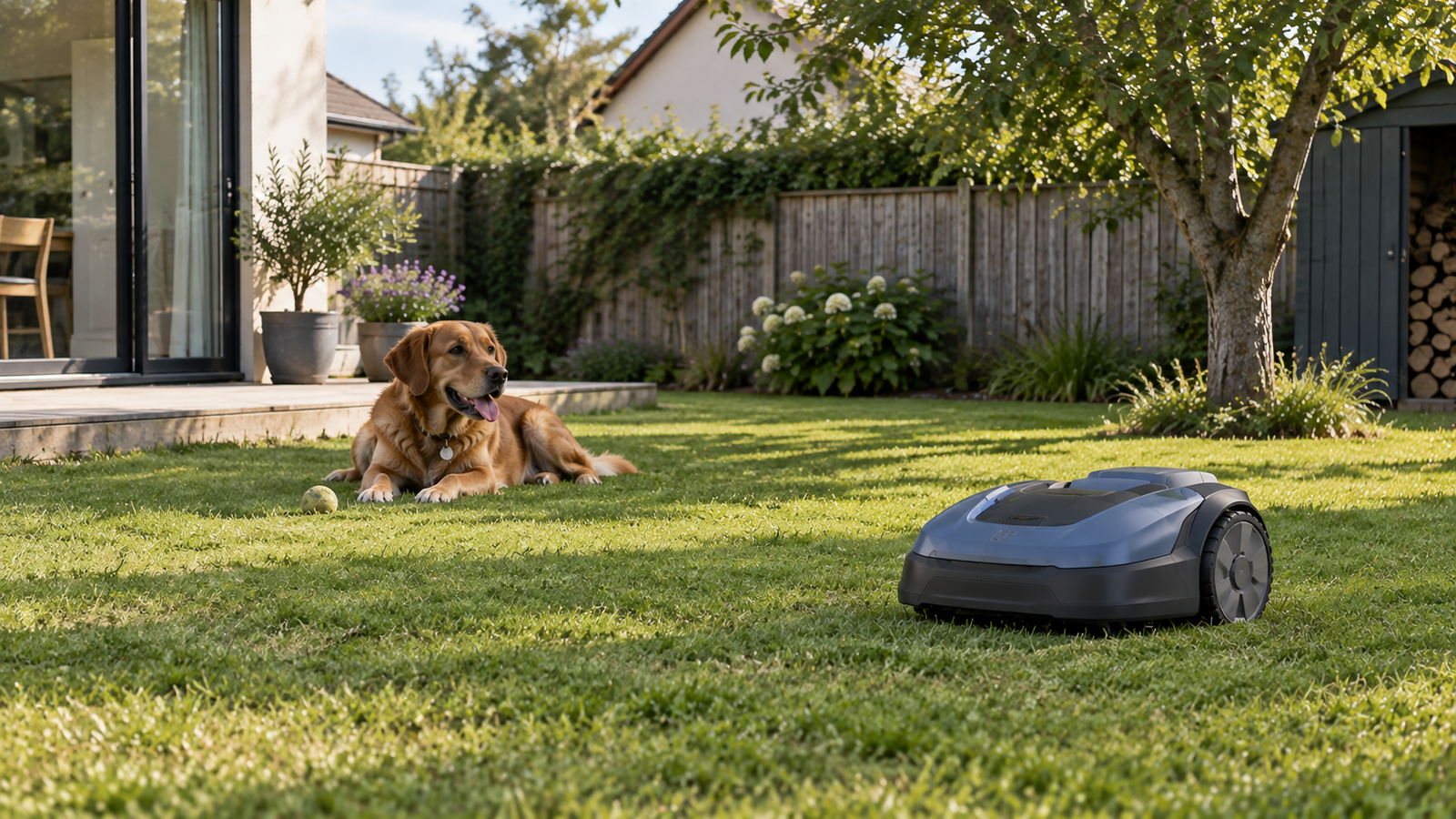
Robot lawn mowers have several built-in safety systems, but dogs and other pets introduce situations that obstacle sensors alone cannot solve.
A dog may chase the mower, leave toys in its path or simply decide that the moving machine is something worth investigating. The safest setup is therefore not just choosing a mower with good sensors — it is scheduling it so pets and the mower don’t need to share the lawn.
The quick answer
Robot lawn mowers can be used in homes with dogs and pets, but pets should ideally be indoors or away from the mowing area while the mower is operating.Lift and tilt sensors, enclosed blades and obstacle detection add protection, but they should be treated as backup safety features rather than permission to let a pet interact with the mower.
In this guide
What safety features should a robot mower have?
The cutting system sits underneath the mower body, rather than being exposed at the front or sides. Modern machines can also use several sensors to stop or alter their behaviour when something unexpected happens.
Useful features include:
- Lift sensors that stop the cutting system if the mower is picked up
- Tilt sensors that stop the blades if the machine tips excessively
- Collision sensors that detect physical contact with obstacles
- Camera or AI obstacle detection on compatible models
- Manual stop controls for quickly stopping the machine
Don’t assume every mower has the same combination. For example, some Husqvarna models have lift and tilt sensors but no object detection, while newer camera-equipped models add visual object detection.
That is worth checking model by model rather than relying on the general claim that robot mowers have “safety sensors”.
What if your dog chases or attacks the mower?
This is one of the situations technology cannot reliably solve for you.
Some dogs ignore a robot mower after becoming familiar with it. Others may bark at it, chase it, paw it or try to bite the moving machine.
If your dog shows that behaviour, don’t rely on obstacle avoidance to manage the interaction.
The practical solution is simple: schedule mowing for times when the dog is indoors or otherwise separated from the lawn.
Robot mowers are particularly well suited to this because they don’t need you to be outside while they work. A mowing schedule can be arranged around when the garden is normally being used.
Will a robot mower detect a dog?
It depends on the mower.
Traditional robot mowers may primarily detect an obstacle after physical contact. Newer vision systems can recognise objects before reaching them.
For example, WORX says its Vision Cloud system can recognise people and animals and actively avoid them.
However, object detection should still be considered an additional safety layer rather than a guarantee. Pets move unpredictably and recognition performance varies between machines and conditions.
What about dog toys?
Pick them up before mowing.
This is especially important for small balls, rope toys, chews and flat objects. A sensor that detects a dog or garden chair may not necessarily recognise something only a few centimetres high.
WORX, for example, states that its older ultrasonic Anti-Collision System detects obstacles above a certain height, while smaller dog toys and sticks may still be pushed or run over.
A quick lawn check before mowing remains worthwhile even with sophisticated obstacle detection.
Food bowls, leads and other pet equipment
Anything routinely left on the grass should be considered part of your robot-mower setup.
Move lightweight bowls, long leads, tethering cables and toys out of the mowing area. Flexible objects are particularly undesirable because they can potentially become caught around moving parts rather than behaving like a solid obstacle.
If something needs to remain permanently in the garden, consider whether your mower allows a no-go zone to be created around it.
Choosing a mower for a pet-friendly garden?
Compare navigation, obstacle detection, lawn capacity, slopes and other features before choosing a model.
What happens if a robot mower runs over dog mess?
This is less a sophisticated safety question and more a very practical reason to inspect the lawn.
If the mower runs through dog mess, its wheels can spread it across the grass and it can contaminate the underside of the machine.
That turns a quick garden clean-up into a considerably less pleasant robot-mower cleaning job.
If you have a dog that regularly uses the lawn, checking and clearing the grass before the mower starts is one of the most useful habits you can develop.
What’s the safest routine with pets?
A sensible routine doesn’t need to be complicated:
- Check the lawn for pet mess, toys and other small objects
- Bring pets indoors or separate them from the mowing area
- Run the mower during a predictable daytime window
- Let the mower return to its charging station before pets use the lawn again
This also avoids another problem: constantly stopping and restarting the mower because the garden is being used.
STIHL’s current guidance specifically recommends keeping children and animals off the lawn during active mowing times. It also recommends daytime operation to reduce risks to nocturnal wildlife.
What about cats?
The same basic rule applies: don’t deliberately encourage a cat or other animal to interact with an operating mower.
Cats may be more inclined to move away from an approaching machine than some dogs, but individual behaviour is unpredictable.
Scheduling the mower for a quiet period remains preferable to depending on the animal to avoid it.
What should pet owners check before buying?
If you have pets, look beyond lawn size and price when comparing models.
- Does it have lift and tilt sensors?
- Does it detect obstacles before contact or only after bumping them?
- Can its camera system recognise animals?
- Can you create no-go areas?
- Can mowing times easily be scheduled around when pets use the garden?
- Can you quickly park or stop the mower from the app?
Advanced object detection is particularly useful in a busy garden, but it shouldn’t replace good mowing habits.
Are robot lawn mowers suitable for homes with dogs?
Yes, provided the mower and the pet aren’t expected to share the lawn while mowing is taking place.
Modern safety sensors and obstacle detection are valuable, but the most effective precaution costs nothing: schedule the mower for a time when your dog is indoors and clear toys and pet mess before it starts.
If pets regularly use your garden, prioritise easy scheduling and good obstacle detection when comparing mowers — but treat those features as additional protection, not a substitute for keeping animals away from an operating cutting machine.
Find the right robot mower for your garden
Use your lawn size, slopes and priorities to narrow down suitable models, or compare robot mowers side by side.