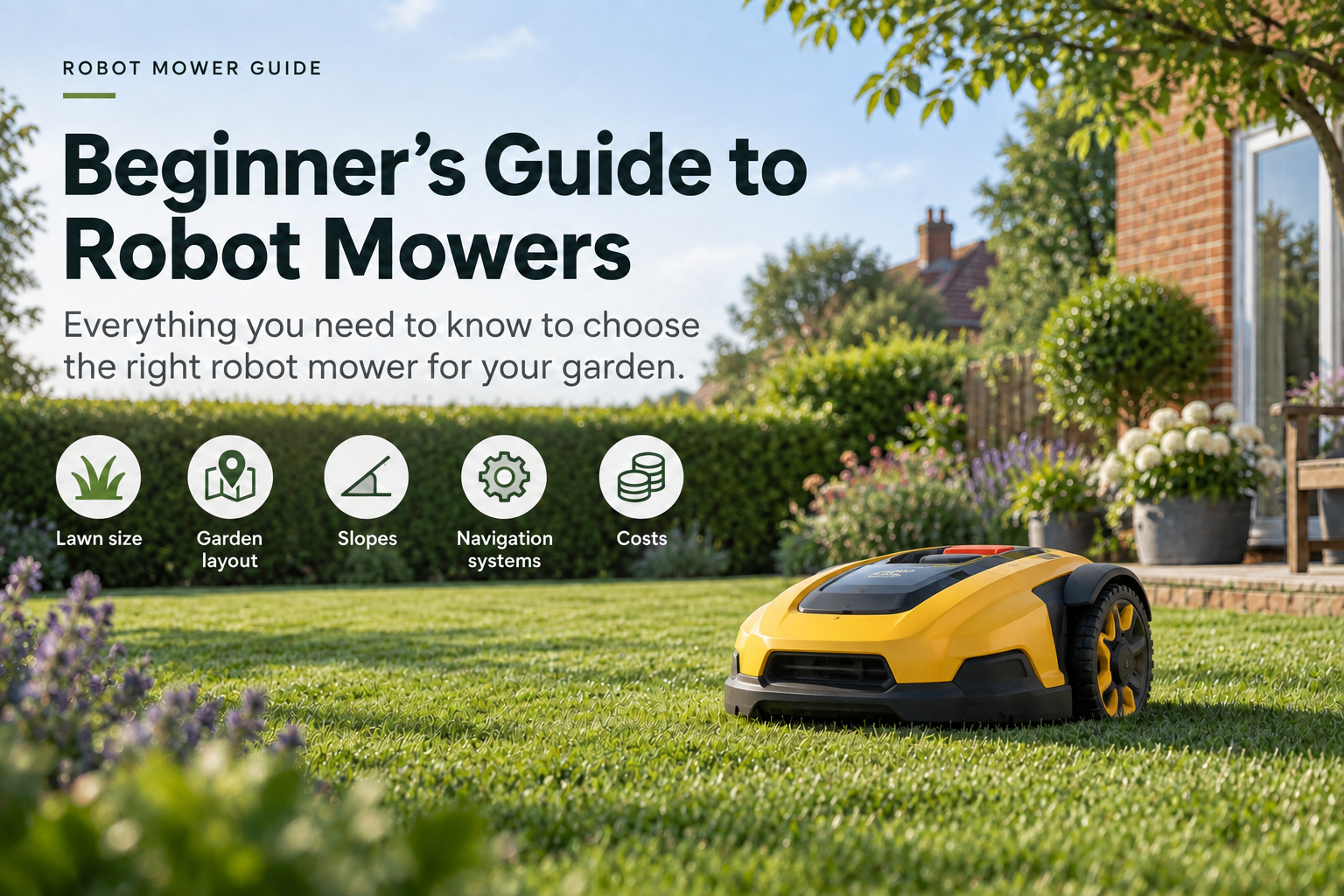
If you’re considering buying your first robot mower, the number of different models, navigation systems and specifications can make choosing one seem more complicated than it needs to be.
The basic idea is simple: a robot mower regularly cuts your lawn for you, allowing you to spend less time mowing and helping to maintain a consistently neat lawn.
The important part is choosing a mower that suits your lawn size, layout and conditions. This beginner’s guide explains the main things you need to know before buying.
The quick answer
Robot mowers cut your lawn automatically, little and often. The right mower depends mainly on your lawn size, garden layout, slopes and obstacles, and whether you need a boundary-wire or wire-free system.
In this guide
- What is a robot mower?
- How does a robot mower know where to go?
- How large is your lawn?
- Do you have more than one lawn area?
- Can robot mowers handle slopes?
- What happens to the grass clippings?
- How do robot mowers charge?
- What about obstacles?
- How often does a robot mower cut the lawn?
- Do robot mowers work in the rain?
- How much maintenance does a robot mower need?
- How much should you spend?
- What should a beginner look for?
- Are robot mowers worth it?
1. What is a robot mower?
A robot mower is a battery-powered lawn mower designed to move around your lawn and cut the grass automatically.
Rather than waiting until the grass becomes long and then removing a large amount in one cut, robot mowers are generally designed to mow regularly. They remove small amounts of grass each time they operate.
Most models return to a charging station automatically when their battery is running low and resume mowing according to their schedule or settings.
Depending on the model, you may also be able to control mowing schedules, cutting settings and other features through an app.
2. How does a robot mower know where to go?
This is one of the biggest differences between robot mowers.
There are several approaches, and understanding them will make comparing models considerably easier.
3. Boundary-wire robot mowers
Traditional robot mowers use a physical boundary wire installed around the edge of the mowing area.
The mower detects this wire and uses it to stay within the lawn.
Boundary-wire systems can work very well once installed, but the initial installation requires more effort. Changing the layout of the mowing area later can also mean repositioning the wire.
4. Wire-free robot mowers
Many newer robot mowers can operate without a physical boundary wire.
Depending on the model, they may use technologies including satellite positioning, RTK, cameras, vision systems or LiDAR to understand their position and surroundings.
Wire-free installation can be more flexible, particularly if you expect the layout of your garden to change, but not every navigation technology is equally suitable for every garden.
Trees, buildings, narrow areas and the complexity of the lawn can all affect which system is most appropriate.
5. How large is your lawn?
Lawn size should be one of the first specifications you check.
Robot mowers are normally given a maximum recommended mowing area, usually measured in square metres.
You don’t necessarily need the mower with the largest possible coverage. You need one with sufficient capacity for the area you actually want it to maintain.
As a starting point, work out the approximate total area of your lawn and compare this with the rated lawn coverage of the models you’re considering.
Remember to include all lawn areas you expect the mower to cut.
6. Do you have more than one lawn area?
A simple rectangular lawn is very different from a garden containing several separate grass areas, narrow passages and obstacles.
Consider whether your garden has:
- more than one lawn
- narrow passages
- separate mowing zones
- trees or planted areas
- paths crossing the lawn
- complex boundaries
- areas the mower cannot travel between itself
A mower that looks suitable based purely on lawn size may not necessarily be the best choice for a complicated garden.
Garden layout and navigation capability should therefore be considered together.
7. Can robot mowers handle slopes?
Many robot mowers can handle gradients, but their maximum slope capability varies considerably.
If your lawn is reasonably flat, this may not be an important deciding factor.
For a sloping garden, however, it should be one of the specifications you check carefully.
The steepest part of the lawn matters more than the average gradient. If you have a particularly steep section, compare its approximate gradient with the maximum supported slope of the mower.
Traction can also be important on more demanding terrain.
8. What happens to the grass clippings?
Robot mowers generally cut very small pieces from the grass rather than collecting clippings in a grass box.
These fine clippings are left on the lawn.
Because the mower operates regularly, the amount removed during each cut is small. This is quite different from conventional mowing where longer grass may be cut every week or two and then collected.
It also means a robot mower is primarily designed to maintain a lawn rather than tackle heavily overgrown grass.
9. How do robot mowers charge?
Most robot mowers use a charging station installed near the lawn. When the battery starts running low, the mower automatically returns to the station and recharges.
Once charged, it can continue mowing according to its schedule, so you normally don’t need to plug the mower in manually between cuts.
The charging station needs access to an outdoor power supply and should be positioned according to the manufacturer’s guidance. The exact setup varies between models, so it is worth considering where the charging station will go before choosing a mower.
Ready to compare robot mowers?
Once you understand the basics, you can start comparing robot mowers that suit your garden. Use our comparison tool to narrow down the options by lawn size, features and price.
10. What about obstacles?
Obstacle handling varies between models.
Some mowers mainly rely on physical contact sensors, while more advanced machines may use cameras, vision systems or other sensors to identify and navigate around objects.
Even with sophisticated obstacle detection, it is sensible to keep the lawn reasonably clear and follow the manufacturer’s installation and operating guidance.
If your garden regularly contains lots of obstacles, obstacle handling deserves more attention when comparing models.
11. How often does a robot mower cut the lawn?
One of the main differences between a robot mower and a conventional mower is the way it approaches the job.
Instead of mowing the entire lawn manually once it becomes visibly long, a robot mower can maintain it through frequent automated cutting.
Exactly how often it should mow depends on factors such as the mower, lawn size, grass growth, season and the settings you choose.
Many models allow schedules to be configured so mowing happens automatically at suitable times.
12. Do robot mowers work in the rain?
This varies between models.
Robot mowers are outdoor machines, but manufacturers take different approaches to mowing in wet conditions. Some models include rain detection or weather-related functionality, while others may be designed to continue operating in certain conditions.
Even when a mower is capable of operating in wet weather, cutting performance and traction can differ from dry conditions.
Check the guidance for the particular mower rather than assuming every robot mower behaves in the same way.
13. How much maintenance does a robot mower need?
Robot mowers remove much of the routine work involved in mowing, but they are not maintenance-free.
Typical ownership tasks can include:
- cleaning grass and debris from the mower
- checking and replacing cutting blades when required
- inspecting wheels and moving parts
- keeping sensors or cameras clean
- checking the charging station
- installing software or firmware updates
- preparing or storing the mower appropriately during winter
The exact maintenance requirements vary by manufacturer and model.
14. How much should you spend?
Robot mower prices vary significantly.
Rather than choosing purely on price, decide which capabilities your garden actually requires.
A relatively straightforward small lawn may not need an expensive mower with the most sophisticated navigation system available.
A large, steep or complicated garden may justify spending more for greater lawn coverage, stronger navigation, better obstacle handling or improved terrain capability.
The aim is not to buy the mower with the longest specification list. It is to avoid paying for features you don’t need while making sure the mower can handle the features of your garden that actually matter.
15. What should a beginner look for?
For your first robot mower, concentrate on the fundamentals before comparing smaller features.
Start with:
- Lawn size — how many square metres need mowing?
- Garden layout — is the lawn simple or complex?
- Slopes — how steep is the steepest part?
- Lawn areas — is there one lawn or several?
- Navigation — do you want boundary wire or wire-free operation?
- Obstacles — how demanding is the garden?
- Budget — how much do you realistically want to spend?
Once you’ve narrowed those down, features such as app controls, mowing patterns, security features and other conveniences become easier to compare.
16. Are robot mowers worth it?
For the right garden and owner, a robot mower can remove a significant amount of repetitive lawn maintenance.
The main benefit isn’t simply that the mower is robotic. It’s that regular mowing can happen automatically without you having to get the conventional mower out each time the grass needs cutting.
Whether that convenience represents good value depends on your garden, how much you currently mow and how much you value reducing that work.
Choosing an appropriate model is therefore much more important than simply deciding whether robot mowers as a category are worthwhile.
What matters most
- Choose a mower with enough capacity for your lawn size.
- Make sure its navigation system suits your garden layout.
- Check that it can handle your lawn’s slopes and separate areas.
- Consider where the mower and charging station will be installed.
- Compare useful features rather than simply choosing the most expensive model.
- Allow for your budget, maintenance and any ongoing costs.
Ready to find the right robot mower?
Now you know the basics, the next step is to find a robot mower that suits your garden. Compare models by lawn size, navigation system, features and price, or use our mower finder to narrow down the options.