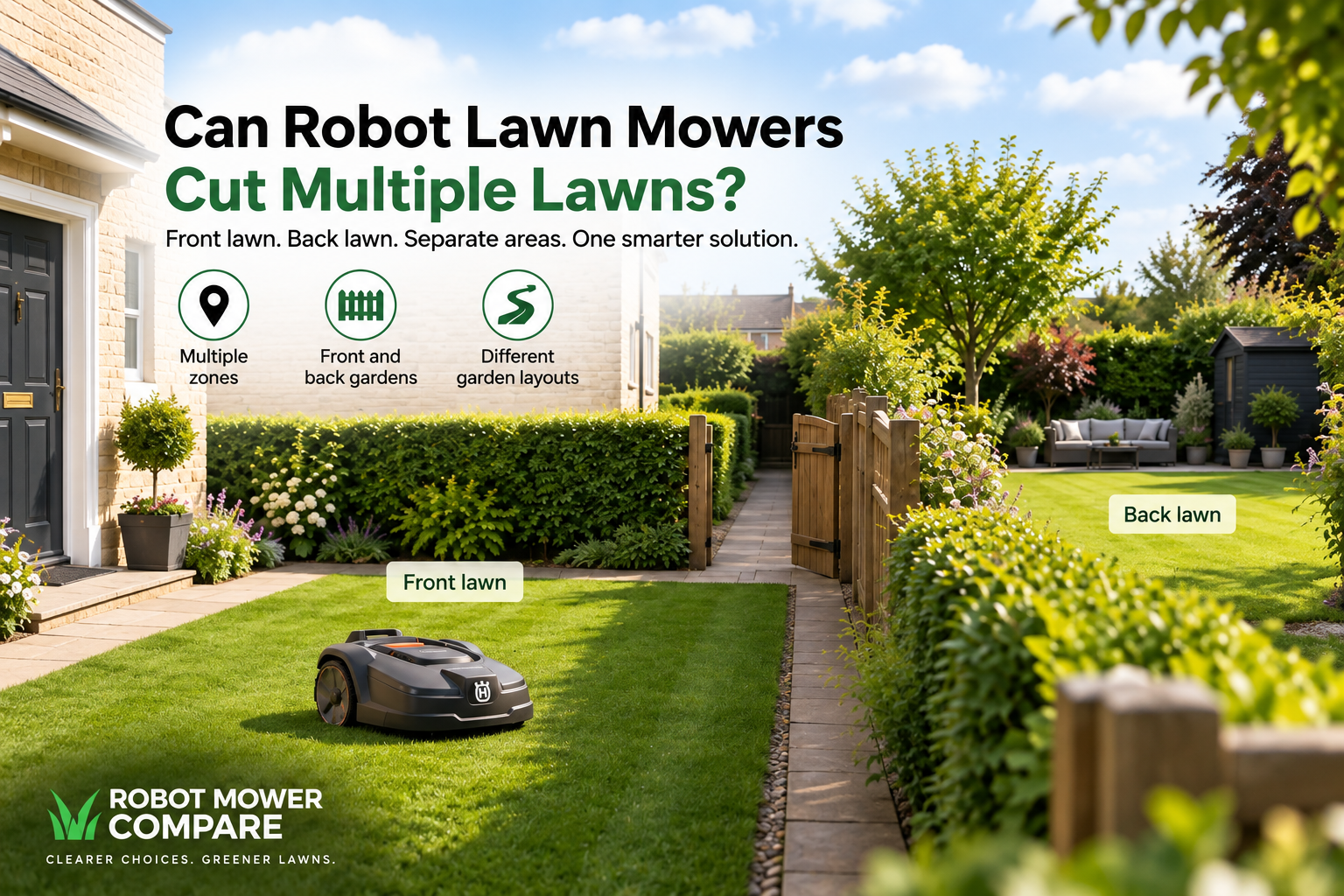
Yes, one robot lawn mower can often manage multiple lawn areas — but only if the mower and garden layout allow it. The important distinction is whether your lawns are connected by a route the mower can travel itself, or are completely separate areas that require the mower to be moved manually.
Before buying, check how the mower handles zones, passages and virtual boundaries rather than assuming that “multi-zone” means it can automatically move between every lawn in your garden.
The quick answer
If your front and back lawns are connected by a mowable strip or suitable passage, many robot mowers can be configured to manage them as different zones. If the lawns are separated by steps, a locked gate, gravel, a public pavement or another route the mower cannot safely cross, you may need to carry the mower between areas or use a different setup.
In this guide
Can one robot mower cut multiple lawns?
In many gardens, yes. Modern robot mowers can often divide a garden into several mowing zones or areas. This can be useful for a front lawn, back lawn, side lawn or sections that need different mowing schedules.
The key question is not simply how many zones the mower supports. It is whether the mower can physically navigate between those zones.
Think of these as two separate capabilities:
- Multiple-zone support: the mower can recognise and manage more than one defined mowing area.
- Automatic travel between zones: the mower can actually drive from one area to another and return to its charging station.
A mower may support multiple areas without being able to travel autonomously between every possible garden layout.
What does multi-zone mowing actually mean?
A zone is a defined part of the garden that the mower can treat separately. Depending on the mower and app, you may be able to create different mowing areas, schedules, cutting settings or exclusion zones.
For example, you might have a 300 m² back lawn and a 100 m² front lawn. A suitable mower could potentially map both while treating them as separate mowing zones.
This is useful when one lawn grows faster, is used more frequently or needs mowing at different times.
However, the combined lawn area still matters. In that example, you should assess the mower against approximately 400 m² of grass rather than treating each lawn independently when considering overall mowing capacity.
Can a robot mower cut front and back gardens?
Potentially, but look carefully at the route between them.
If the front and back lawns are connected by a suitable side passage, a mower may be able to travel between the two areas automatically. Some wire-free systems allow connecting routes or channels to be mapped between mowing zones.
A typical workable layout might be:
Back lawn → side passage → front lawn
The passage itself does not necessarily need to be an area you want mown, but the mower must be capable of travelling along it safely and the system must support that type of connection.
A completely enclosed back garden with no mower-accessible route to the front is different. No navigation technology can overcome a physical barrier such as steps or a closed gate.
What about paths, gates and narrow passages?
Paths and paving
Some robot mowers can travel across suitable hard surfaces to move between mowing areas. Whether this works depends on the mower, the surface, kerbs or steps and how the connecting route can be configured.
A flat paved path level with the lawn is very different from a raised patio edge or flight of steps.
Gates
A gate can be one of the simplest reasons a multi-zone setup fails in practice. The mower needs the route to be physically open when it travels through.
If you normally keep a side gate closed for security, pets or children, consider this before relying on automatic travel between front and back lawns.
Narrow passages
Check the manufacturer’s minimum passage requirements for the specific mower. A machine may be capable of mapping both lawns but still be unable to negotiate the narrow route connecting them.
Also consider objects that reduce the usable width, including drainpipes, raised beds, walls and overhanging plants.
What if the lawns are completely separate?
This is where buyers need to be particularly careful.
Imagine a property with a large rear lawn and a separate front lawn, with the only route between them involving steps and a public pavement. The mower cannot simply drive itself between those areas.
Depending on the model, it may still be possible to define and mow both areas, but you could need to carry the mower to the secondary lawn.
That changes the ownership experience considerably. Instead of the mower being fully autonomous, mowing the second lawn becomes a manual job you need to remember to initiate.
Before buying specifically for disconnected lawns, check the manufacturer’s instructions for secondary areas and how the mower behaves when operating away from its charging station.
What happens when the mower needs charging?
The charging station is another reason connected and disconnected lawns should be treated differently.
On a connected multi-zone installation, a suitable mower can normally navigate back towards its charging station when required.
If you manually place the mower on a completely disconnected secondary lawn, it cannot physically return to a charging station located elsewhere.
This may mean mowing that area within the available battery charge and manually returning the mower afterwards. The exact behaviour varies by model, so this is an important specification to check if you have physically separate lawns.
Does wire-free make multiple lawns easier?
Wire-free navigation can make creating and adjusting mowing areas more flexible because virtual boundaries can often be edited through an app rather than physically changing perimeter cable.
But “wire-free” does not automatically solve a difficult multi-lawn layout.
RTK, LiDAR and vision systems still need a route the mower can physically traverse if you expect it to move autonomously between areas. Navigation technology cannot allow a mower to climb steps, open gates or safely cross an unsuitable public route.
For a complicated garden, assess both the navigation system and the physical route between lawns.
Five real-world garden layouts
1. Two lawns joined by grass
This is generally the simplest multi-zone arrangement. If the connecting strip meets the mower’s requirements, both areas may function almost like one larger lawn.
2. Front and back lawns joined by a side path
This can work with a mower that supports mapped connecting routes and can safely travel over the path. Check passage width, surface changes and the gate.
3. Lawns divided by a driveway
Whether this is suitable depends heavily on the driveway and how it is used. A private, level crossing within the garden is very different from asking a mower to operate where vehicles regularly move.
4. Two lawns separated by steps
The mower cannot autonomously travel between them. Expect some form of manual transfer if the model supports mowing a secondary disconnected area.
5. Front lawn reached only via a public pavement
This should not be treated like an ordinary connecting passage. Plan on keeping the mower within the property rather than expecting it to navigate public pedestrian space autonomously.
What should you check before buying?
Draw a simple plan of the garden before choosing a mower. Mark each lawn and the route the mower would have to follow between them.
Then check:
- Total grass area across all lawns
- Whether the mower supports multiple mowing zones
- Whether zones can be connected for automatic travel
- Minimum passage width
- Steps, kerbs and changes in surface height
- Whether gates will remain open when required
- How the mower crosses paths or other non-grass surfaces
- Whether any lawn is completely disconnected
- How a secondary area is mown and charged
- Whether the mower can autonomously return to its charging station
This tells you considerably more than simply checking the mower’s maximum lawn-area figure.
How we compare robot mowers
Robot Mower Compare uses product specifications and information checked primarily against manufacturer sources. Our ratings are editorial comparison ratings and should not be interpreted as hands-on testing unless we specifically state that a product has been personally tested.
Find the right robot mower for your garden
Use your lawn size, slopes and priorities to narrow down suitable models, or compare robot mowers side by side.