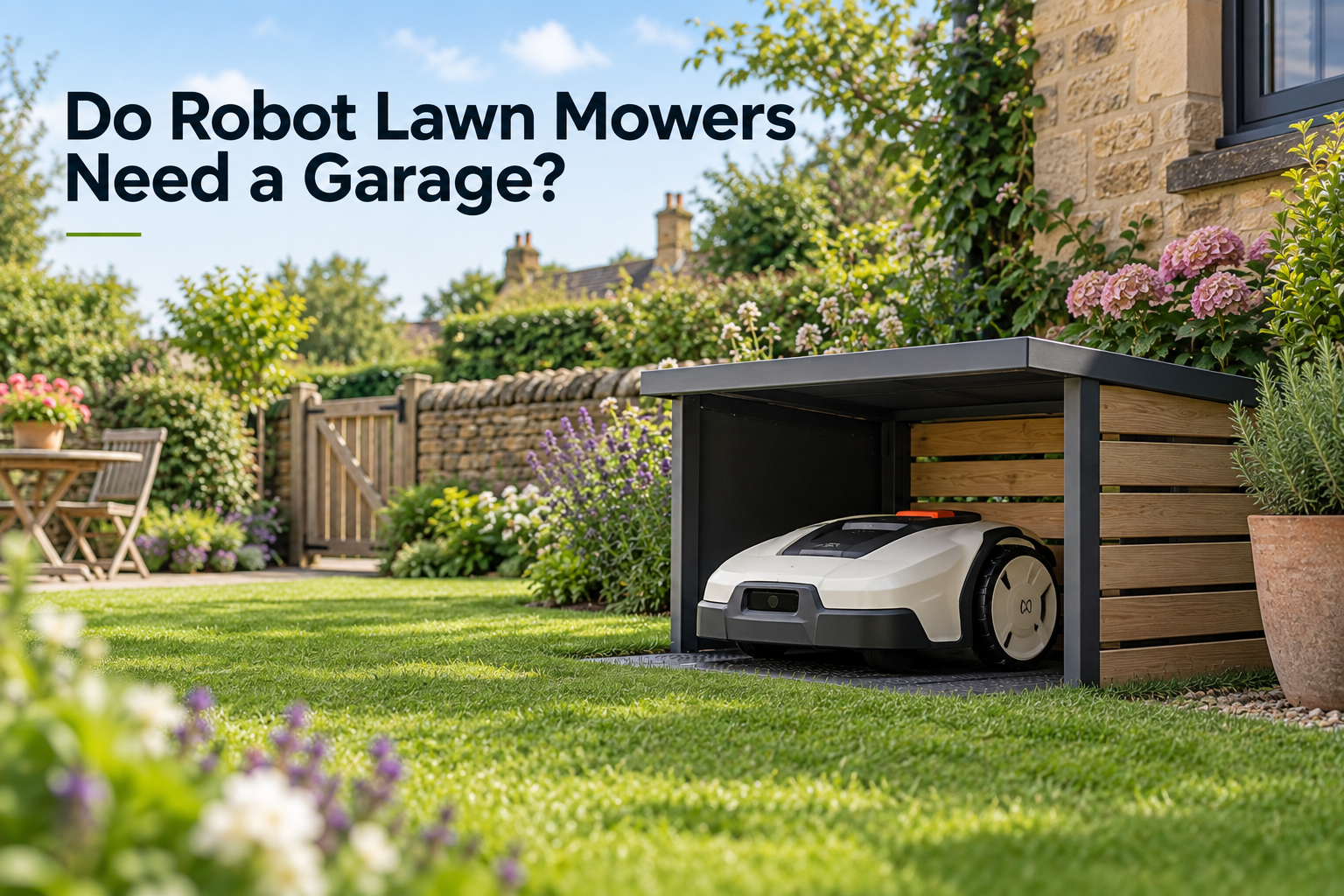
Robot lawn mowers are designed to spend much of the mowing season outdoors, often returning to their charging station several times a day. That raises a common question: does the mower and charging station actually need a garage or shelter?
For most robot mowers, a garage is optional rather than essential. However, it can provide useful extra protection from prolonged sun, heavy rain and debris — and there are some important things to consider before buying or building one, particularly with modern wire-free mowers.
The quick answer
Most robot lawn mowers do not need a garage or mower house. They are designed for outdoor use, and many can safely remain at an uncovered charging station throughout the mowing season. A suitable garage can still provide extra protection from prolonged sun, heavy rain and debris, but it must not interfere with docking, ventilation or the mower’s navigation system.
In this guide
- Do robot lawn mowers need to be kept under cover?
- What does a robot mower garage actually do?
- Can a garage help protect the battery?
- Are there any disadvantages to a robot mower garage?
- Can a mower garage affect wire-free navigation?
- Manufacturer garage or DIY mower house?
- What about winter?
- Is a robot mower garage worth buying?
Do robot lawn mowers need to be kept under cover?
Usually, no.
Robot lawn mowers are outdoor machines, so you shouldn’t normally need to put your mower away whenever it rains.
For example, Husqvarna says its Automower models are designed to work in different weather conditions, while WORX describes its Landroid mowers as weather-resistant. Their mower garages are therefore additional protection rather than something required for normal operation.
This is different from winter storage. Leaving a mower at its charging station during the mowing season and storing it through months of frost and bad weather are separate issues.
What does a robot mower garage actually do?
A robot mower garage is usually a small open-sided shelter positioned over the mower’s charging station.
Its main purpose is to reduce the amount of time the mower spends exposed to the elements while it is parked and charging.
A suitable garage can provide extra protection from:
- Prolonged direct sunlight
- Heavy rain
- Dirt and falling debris
- Bird mess and tree sap
- Long-term weather exposure
Husqvarna says its Automower House protects the mower against the long-term effects of rain and sun. WORX also sells garages designed to protect compatible mowers and their charging bases from rain, sun and dirt.
A garage doesn’t suddenly make an unsuitable mower weatherproof. It is better thought of as extra protection for a machine that is already designed to work outdoors.
Can a garage help protect the battery?
Potentially, particularly by providing shade.
A mower sitting at its charging station in strong direct sunlight can become considerably warmer than one parked beneath a canopy.
STIHL recommends installing its iMOW docking station in a shaded, sheltered location where possible. It notes that direct sunlight can increase the mower’s temperature and result in longer battery charging times.
If your charging station already sits naturally in shade for much of the day, this particular benefit may be less important.
Are there any disadvantages to a robot mower garage?
There can be.
The mower needs enough space to enter and leave its charging station reliably. A poorly designed garage could obstruct docking, make access for maintenance more difficult or restrict airflow around the mower and charging equipment.
This is particularly important if you’re thinking about building your own mower house rather than buying one designed for your model.
Make sure there is sufficient clearance around the mower and avoid building an enclosure that is unnecessarily tight or poorly ventilated.
Can a mower garage affect wire-free navigation?
This is particularly important with modern wire-free robot mowers.
Some wire-free mowers rely on satellite signals, cameras or other technology to work out where they are in the garden. Because of this, you need to be a little more careful about where you put their charging station and what you build around it.
For example, Mammotion advises against using thick metal materials for a DIY mower garage because they can interfere with the satellite signals used by some of its mowers.
That doesn’t mean a wire-free mower can’t have a garage. Manufacturer-designed shelters are available for many models, including mowers that use satellite navigation.
The important point is that not every mower has the same requirements. A garage that works perfectly well with one model may not be suitable for another.
Before buying or building a mower house, check the instructions for your particular mower. Pay particular attention to where the charging station needs to be positioned and whether the manufacturer recommends keeping the area above or around it clear.
Manufacturer garage or DIY mower house?
Both can work.
A manufacturer-designed garage is usually the simplest option because it has been designed around compatible mower and charging-station dimensions.
WORX, Husqvarna, Mammotion and other manufacturers offer dedicated shelters for at least some of their robot mower ranges.
The downside is price. A relatively simple manufacturer garage can be considerably more expensive than building a basic shelter yourself.
A DIY mower house can work perfectly well, but check that:
- The mower has plenty of entrance and exit clearance
- Nothing obstructs the docking process
- Air can circulate around the mower and charger
- The shelter doesn’t trap excessive heat
- The materials won’t interfere with the mower’s navigation signals
- You can easily reach the mower and charging station for cleaning and maintenance
A simple open-sided roof is often more sensible than trying to build a completely enclosed miniature shed.
What about winter?
A mower garage shouldn’t be confused with proper winter storage.
When the mowing season ends, some manufacturers recommend bringing the robot mower indoors rather than simply leaving it outside beneath its garage throughout the winter.
Husqvarna, for example, recommends storing Automower in a dry, frost-free environment. STIHL also recommends indoor winter storage for its iMOW mowers.
The instructions for the mower, charging station and power supply can differ between manufacturers, so follow the guidance for your particular model.
A mower house that is useful during spring and summer therefore doesn’t necessarily make it suitable to leave the mower outside all winter.
So, is a robot mower garage worth buying?
For most people, a robot mower garage is a useful optional accessory rather than a necessity.
It makes more sense if your charging station will sit in an exposed part of the garden with strong summer sun, heavy rain or falling debris. It can help keep the mower cleaner and provide additional protection during the many hours it spends parked and charging.
If the charging station is already in a naturally sheltered position, the benefit may be smaller.
It’s also worth considering the price. Spending a significant amount on a manufacturer-branded garage isn’t automatically worthwhile simply because one is available.
The better question is:
Will a garage provide useful extra protection where my charging station actually needs to be installed?
If the answer is yes, it can be a worthwhile addition. If the mower already has a suitable sheltered charging position, you probably don’t need to rush out and buy one.
Summary
Most robot lawn mowers do not need a garage or mower house during the normal mowing season. They’re designed to operate outdoors, and an uncovered charging station is acceptable for many models.
A garage can still be useful for providing extra shade and protection from prolonged rain, sun and debris.
If you have a modern wire-free mower, check the manufacturer’s installation requirements before buying or building a shelter. Some models rely on satellite signals or other navigation technology, so the position and materials of the garage can matter.
And remember that a mower garage isn’t a substitute for proper winter storage where the manufacturer recommends bringing the mower indoors.
Find the right robot mower for your garden
Use your lawn size, slopes and priorities to narrow down suitable models, or compare robot mowers side by side.