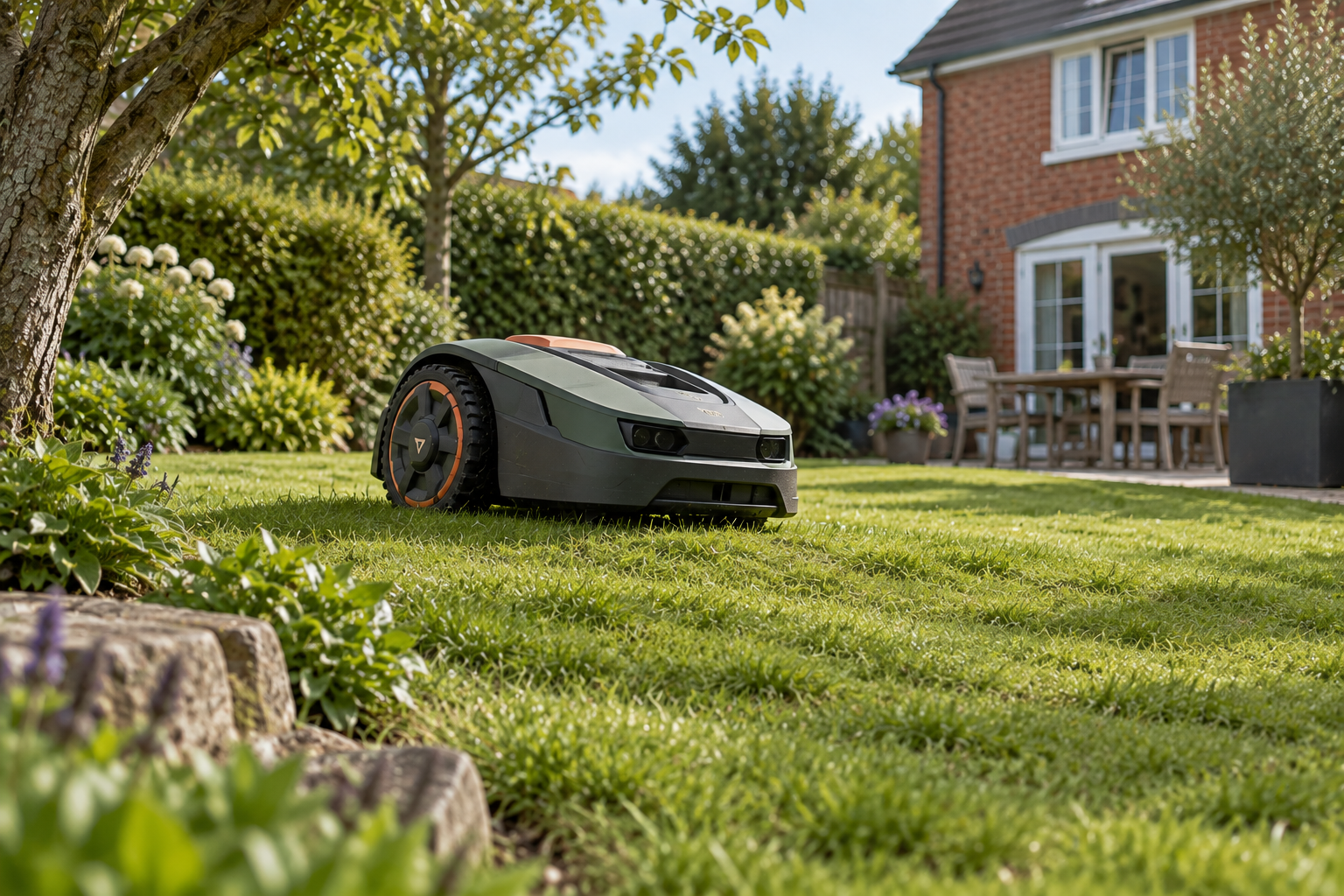
Robot lawn mowers don’t need a perfectly flat lawn, but bumps, dips, exposed roots and soft ground can make life more difficult for them.
Most modern robot mowers can cope with the normal unevenness found in UK gardens. The bigger question is how rough the lawn actually is — and whether the mower has the traction, ground clearance and cutting system needed to deal with it.
The quick answer
Most robot lawn mowers can handle a reasonably uneven or bumpy lawn. Small dips, gentle undulations and minor imperfections are unlikely to cause serious problems.
Very rough ground can be more challenging. Deep holes, pronounced bumps, exposed roots, muddy patches and sudden changes in level can cause a mower to lose traction, get stuck or cut the grass unevenly. Choosing a mower designed for more difficult terrain — and fixing the worst areas of the lawn — can make a significant difference.
In this guide
- How uneven can a lawn be for a robot mower?
- Why do robot mowers struggle with rough ground?
- What features help on uneven lawns?
- Does four-wheel drive make a difference?
- What about holes, tree roots and muddy ground?
- Should you level the lawn before buying a robot mower?
- What should you look for when choosing a mower?
- Are robot lawn mowers suitable for uneven gardens?
How uneven can a lawn be for a robot mower?
A lawn doesn’t need to be perfectly level.
Normal garden undulations, shallow dips and slightly uneven areas are usually manageable, particularly with a mower designed to adapt to changes in the ground beneath it.
Manufacturers increasingly design robot mowers with uneven terrain in mind. For example, WORX uses self-levelling cutting systems on some Landroid models, while Husqvarna uses movable front axles on some models to improve manoeuvrability over rough terrain.
Problems are more likely when the lawn has deep holes, sharp ridges, large exposed roots or abrupt changes in level.
There’s no universal specification telling you exactly how bumpy a lawn can be. Unlike maximum slope, which manufacturers commonly publish, unevenness is difficult to express as a single useful number.
Why do robot mowers struggle with rough ground?
A robot mower is relatively small and travels close to the ground.
If one wheel drops into a deep hole or the centre of the mower becomes caught on a raised section, its drive wheels may lose traction.
Uneven ground can also affect the cut. A mower travelling over a pronounced hump may bring its cutting system unusually close to the turf, potentially resulting in a very short or scalped patch.
This is one reason some manufacturers use floating or self-levelling cutting systems. WORX, for example, says its self-levelling cutting deck follows the natural unevenness of the lawn and helps prevent scalping.
What features help on uneven lawns?
If your garden is noticeably uneven, look beyond lawn-area capacity when comparing mowers.
Useful features include:
- Large drive wheels for better traction and easier movement over small imperfections
- Good ground clearance to reduce the chance of the mower becoming grounded
- Floating or self-levelling cutting decks that can adapt to changes in the lawn
- Flexible or articulated chassis designs that help wheels maintain contact with uneven ground
- Strong traction or AWD/4WD for particularly difficult terrain
Not every uneven garden needs all of these features. A typical established UK lawn with a few bumps is very different from a heavily rutted or steep garden.
Does four-wheel drive make a difference?
It can, particularly where uneven ground is combined with steep slopes or poor traction.
Four-wheel-drive and all-wheel-drive robot mowers can keep more wheels driving the mower when the ground becomes difficult.
For example, Mammotion says the LUBA 2 AWD’s adaptive suspension improves movement over uneven terrain and allows it to traverse obstacles or potholes up to 50mm. Husqvarna’s AWD models are designed for more demanding terrain and steep slopes.
WORX’s Vision Cloud 4WD also uses independent front and rear axles designed to adapt to bumps while keeping its wheels in contact with the ground.
That doesn’t mean you automatically need 4WD because your lawn isn’t perfectly flat. For modest bumps and undulations, a conventional robot mower with suitable wheels and a well-designed chassis may be perfectly adequate.
What about holes, tree roots and muddy ground?
These can be more troublesome than ordinary lawn undulations.
A deep hole can trap a wheel, while a prominent tree root can catch the underside of a low mower. Stones and other hard objects can also present a risk to the cutting system.
Soft or muddy areas introduce another problem: traction.
Even a mower that performs well on uneven dry ground may struggle if its wheels sink into wet soil or become clogged with grass and mud. Husqvarna, for example, advises keeping mower wheels clear of accumulated grass because this can affect their ability to negotiate slopes.
If one small area repeatedly becomes waterlogged, improving the drainage or excluding that patch from the mowing area may be more effective than expecting the mower to battle through it. If wet conditions are a regular issue, our guide to using robot lawn mowers in the rain and on wet grass explains what to expect
Should you level the lawn before buying a robot mower?
You don’t normally need to completely level an established lawn before installing a robot mower.
It is worth fixing the worst problem areas, though.
Fill deep holes, remove loose stones and deal with particularly sharp ridges where practical. If large tree roots are exposed, consider whether that area should be excluded from the mower’s working zone rather than trying to make the mower cross it.
The aim isn’t to create a bowling green. It’s simply to remove obstacles that are likely to strand or damage the mower.
What should you look for when choosing a mower?
Start by looking at your garden rather than simply choosing the mower with the highest specification.
If the lawn has only gentle bumps, you may not need a specialist terrain mower at all.
For a rougher garden, pay closer attention to the mower’s wheel size, drive system, chassis movement, ground clearance and cutting-deck design.
If your uneven lawn also includes significant slopes, check the manufacturer’s maximum slope specification separately. A mower being good over bumps doesn’t automatically mean it can handle a steep gradient.
Gardens with several separate or awkwardly connected areas can present a different challenge. See our guide to using robot lawn mowers on multiple lawns for what to consider.
Are robot lawn mowers suitable for uneven gardens?
For many uneven UK gardens, yes.
A few bumps and dips shouldn’t automatically rule out a robot mower. Modern machines can be surprisingly capable, and some are specifically engineered to maintain traction and cutting performance over difficult terrain.
The limits become more apparent when a lawn is extremely rough, deeply rutted, frequently muddy or covered with large exposed roots.
In those situations, choosing a mower with appropriate terrain features is important — but improving the worst parts of the lawn can be just as valuable.
Summary
Robot lawn mowers can generally cope with the everyday bumps and undulations found in many UK gardens.
More difficult terrain requires greater care when choosing a mower. Larger wheels, good ground clearance, adaptable cutting decks and more capable drive systems can all help.
You don’t need to make the lawn perfectly flat before installing a robot mower, but filling deep holes and dealing with obvious obstacles can reduce the chances of it becoming stuck.
For particularly rough, steep or slippery gardens, consider models specifically designed for more demanding terrain.
Find the right robot mower for your garden
Use your lawn size, slopes and priorities to narrow down suitable models, or compare robot mowers side by side