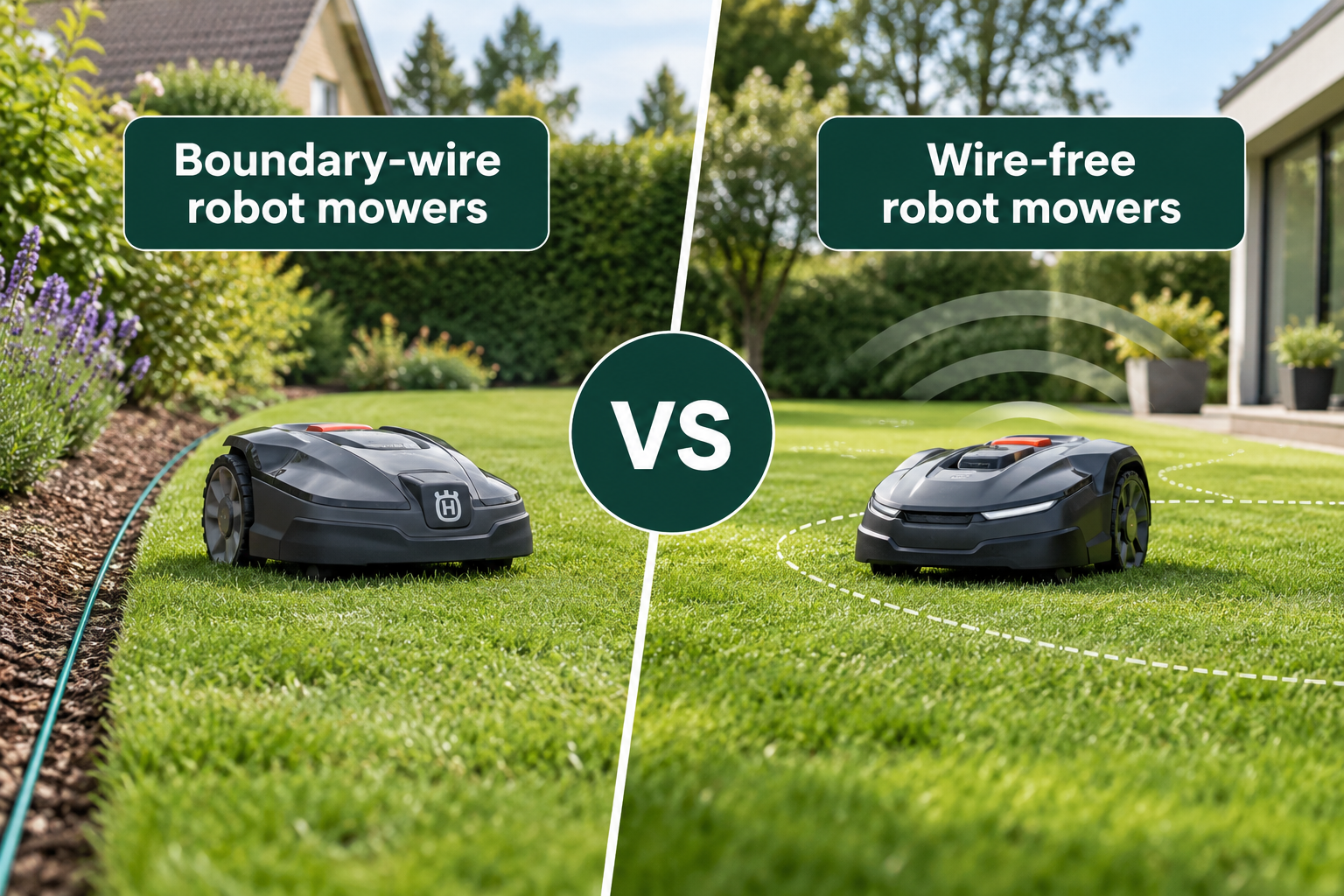
Wire-free robot mowers are becoming increasingly common, but traditional boundary-wire models are still a good choice for many gardens.
The main difference is how the mower knows where it is allowed to cut. Boundary-wire models use a physical cable installed around the lawn, while wire-free models create virtual boundaries using technologies such as satellite positioning, cameras or other sensors.
Neither system is automatically better for every garden. The right choice depends on your lawn layout, installation preferences, obstacles and budget.
The quick answer
Choose a boundary-wire robot mower if you want a proven system and do not mind installing a physical cable around your lawn. Choose a wire-free model if you prefer virtual boundaries and easier boundary changes, provided its navigation technology is suitable for your garden.
In this guide
- How boundary-wire robot mowers work
- How wire-free robot mowers work
- Installation
- Boundary changes
- Navigation reliability
- Trees and buildings
- Obstacles
- Multiple lawn areas
- Cost
- Which system is right for you?
1. How boundary-wire robot mowers work
Boundary-wire robot mowers use a physical cable installed around the edge of the mowing area. The mower detects the signal from this wire and uses it to stay within the lawn.
The wire is usually fixed to the surface with pegs or buried just below the ground. Additional guide wires may also be used to help some models navigate back to their charging station or through more complicated parts of the garden.
Once installed correctly, a boundary wire provides the mower with a clear and consistent mowing area. The main disadvantage is the initial installation and the need to move or repair the wire if the lawn layout changes.
2. How wire-free robot mowers work
Wire-free robot mowers create virtual mowing boundaries instead of relying on a physical perimeter cable.
Depending on the model, navigation may use satellite positioning such as RTK or GNSS, cameras, onboard sensors, or a combination of technologies. The mowing area is usually mapped during setup and stored digitally.
This makes it easier to adjust mowing zones later because you can change virtual boundaries without digging up or moving a cable. However, performance can depend on the navigation system and the conditions in your garden.
3. Compare the installation
Boundary-wire mowers require a cable to be installed around the mowing area. For a simple lawn this can be relatively straightforward, but installation becomes more involved when a garden has several zones, narrow passages, flower beds or other areas that need to be excluded.
Wire-free models avoid installing a perimeter cable. Instead, the lawn is mapped digitally during setup. Some systems may also require additional equipment, such as a reference antenna, so check the installation requirements of the individual mower.
If avoiding physical boundary-wire installation is important to you, a wire-free mower can offer a significant advantage.
4. Think about future boundary changes
Changing the mowing area is one of the clearest differences between the two systems.
With a boundary-wire mower, extending or reshaping the mowing area may require lifting, cutting or repositioning the installed cable. Repairs may also be needed if the wire is accidentally damaged.
With a wire-free mower, boundaries are generally adjusted digitally through the mower’s app or mapping system. This can be useful if you regularly change flower beds, landscaping or other parts of your garden.
If you expect your lawn layout to change over time, virtual boundaries can provide more flexibility.
5. Compare navigation reliability
A boundary wire gives the mower a fixed physical reference for the edge of the lawn. This makes boundary detection predictable and means the mower does not rely on satellite reception to know where the mowing area ends.
Wire-free models depend on their navigation technology. Satellite-based systems may need a sufficiently clear view of the sky, while camera-based and sensor-based systems use different methods to understand their surroundings.
For gardens with heavy tree cover, tall buildings or other features that could affect navigation, check how the specific wire-free system works before choosing a mower.
Ready to compare robot mowers?
Compare wire-free and boundary-wire robot mowers by navigation, lawn size, slope capability, features and price to find the models that suit your garden.
Compare robot mowers → Find my mower →6. Consider trees and buildings
Trees, walls, sheds and buildings can affect some wire-free navigation systems, particularly those that rely heavily on satellite positioning.
A garden with a clear view of the sky may be well suited to satellite-based navigation, while gardens surrounded by tall buildings or dense tree cover can be more challenging.
Boundary-wire systems are less dependent on these conditions because the mower follows the signal from the installed wire. Before choosing a wire-free model, check the manufacturer’s guidance for positioning and signal requirements.
7. Compare obstacle handling
Both boundary-wire and wire-free robot mowers can use sensors to detect obstacles, but the technology and level of detection vary between models.
Some mowers rely mainly on physical collision sensors, while more advanced models may use cameras, ultrasonic sensors or other detection systems to identify objects before reaching them.
If your lawn regularly contains trees, furniture, toys or other obstacles, compare the obstacle-detection capabilities of individual models rather than assuming one boundary system will handle them better.
8. Think about multiple lawn areas
Gardens with separate lawn areas can be more challenging for any robot mower, especially if the mower cannot travel between them without crossing paths, paving or other non-mowing surfaces.
Boundary-wire systems can support multiple zones, but the installation may require additional wiring or guide wires depending on the mower and garden layout.
Wire-free systems can make it easier to define separate mowing zones digitally. However, you still need to check whether the mower can move between those areas automatically or needs to be carried manually.
If your garden has several separate lawns, check the individual mower’s multi-zone capabilities before buying.
9. Compare the cost
Wire-free robot mowers can cost more than comparable boundary-wire models because of the additional navigation technology they use.
With a boundary-wire mower, also consider installation costs. You may install the wire yourself, but professional installation can add to the overall price.
When comparing prices, look at the total cost of the mower, any required navigation equipment and installation rather than the mower’s purchase price alone.
The best value option is the system that works reliably in your garden without paying for technology or features you do not need.
10. Which system is right for you?
A boundary-wire robot mower can be a good choice if you want a proven boundary system, have a relatively stable lawn layout and do not mind installing a perimeter cable.
A wire-free robot mower can be a better fit if you want virtual boundaries, expect to change mowing areas in the future or want to avoid installing a physical wire.
Your garden should make the final decision. Consider its layout, tree and building cover, separate lawn areas and the navigation requirements of each mower before choosing between the two systems.
What matters most
- Installation — Boundary-wire mowers require a physical cable, while wire-free models use virtual boundaries.
- Flexibility — Virtual boundaries are generally easier to change if your lawn layout changes.
- Navigation — Check whether a wire-free mower’s navigation technology is suitable for trees, buildings and other conditions in your garden.
- Multiple areas — Check how the mower handles separate lawns and whether it can travel between them automatically.
- Cost — Compare the mower, installation and any additional navigation equipment when calculating the total price.
Compare robot mowers for your garden
Compare wire-free and boundary-wire robot mowers by navigation, lawn size, slope capability, features and price to find the right model for your garden.
Find my mower →