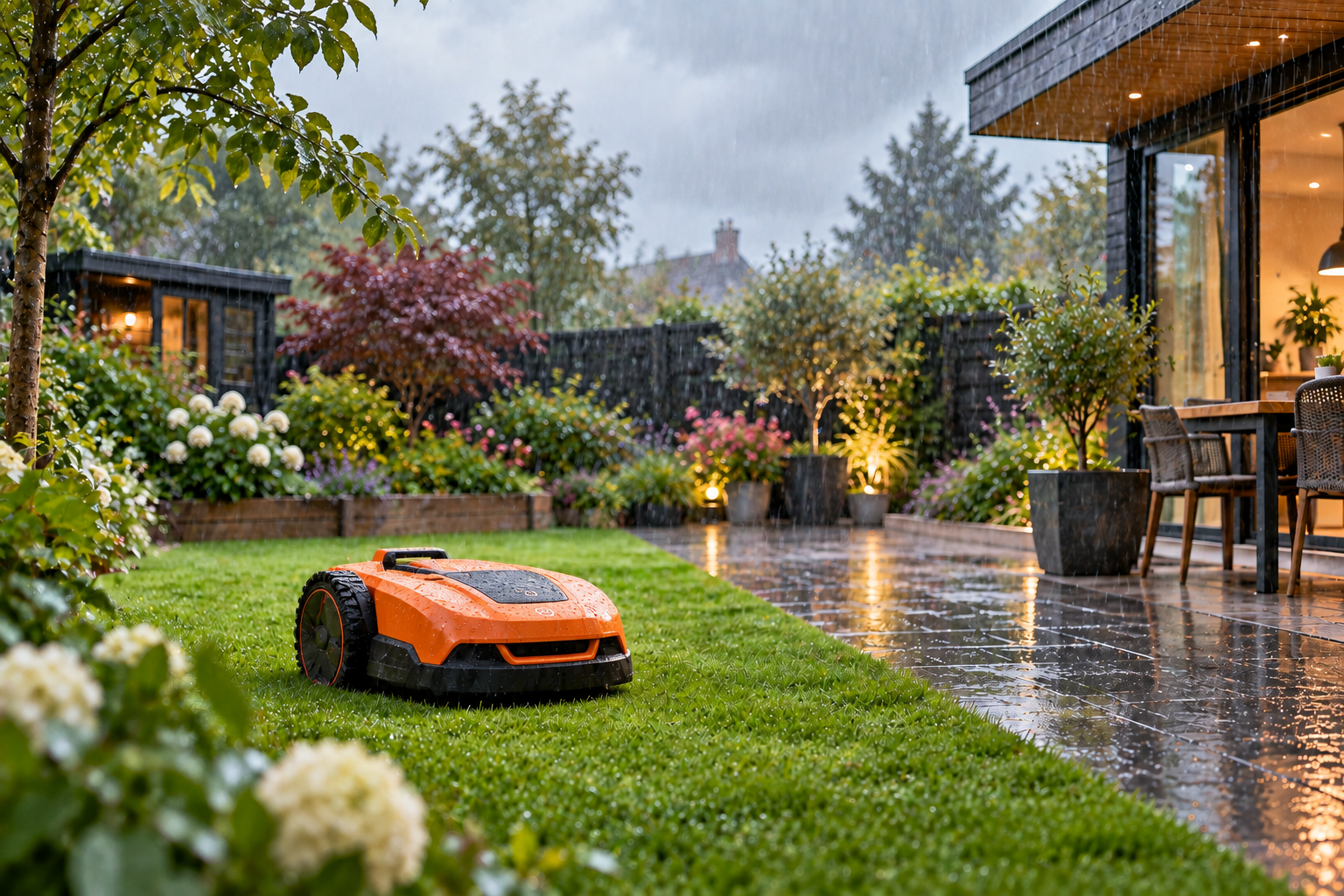
Robot lawn mowers are designed to live outdoors, but that does not mean mowing in heavy rain or on saturated grass is always a good idea. Some models are specifically designed to continue cutting in rain, while others detect wet weather and return to their charging station.
For UK gardens, the bigger issue is often not whether rain will damage the mower. It is what wet grass and soft ground do to cutting performance, traction and the lawn itself.
The quick answer
Many robot lawn mowers can safely be outside in the rain, but whether they should continue mowing is model-dependent. Wet grass can stick around the cutting deck, soft ground can cause wheel marks and slopes become harder to climb. A rain sensor or weather-based mowing delay can therefore be useful even on a fully weatherproof mower.
In this guide
Can robot lawn mowers actually mow in the rain?
Some can. Others deliberately stop.
This is an important distinction because weatherproof and designed to mow wet grass are not the same thing.
For example, Husqvarna specifies weatherproof Automower models that can continue cutting in rainy conditions. STIHL takes a different approach with its iMOW range: an integrated rain sensor can pause mowing in wet weather and resume when conditions improve.
WORX Landroid models can also use rain detection or weather information to delay mowing. ECOVACS states that its GOAT can withstand rain, but recommends using the rain sensor because wet grass can block the blades and water on the camera can affect visual localisation.
So when comparing mowers, don’t simply look for the word “waterproof”. Check what the manufacturer actually recommends the mower should do when it starts raining.
What happens when a robot mower cuts wet grass?
A robot mower does not collect grass into a box. Its small blades repeatedly trim tiny amounts from the top of the grass, leaving the clippings on the lawn.
That system works particularly well when the mower cuts frequently and the grass is reasonably dry.
When grass is very wet, several things can change.
Wet clippings stick underneath the mower
Instead of dropping cleanly back into the lawn, damp clippings can stick to the cutting disc, blade area and underside of the mower.
This doesn’t necessarily stop the mower immediately, but it can mean more frequent cleaning. In persistent wet conditions, enough grass can accumulate to interfere with the cutting area.
The cut may be less clean
Wet grass tends to bend rather than stand upright. This makes it harder for the mower’s small pivoting blades to cut every blade of grass consistently.
One wet mowing session is unlikely to matter much because the mower will return repeatedly, but consistently mowing saturated grass can produce a less even result than mowing in better conditions.
Soft ground is often the bigger problem
After prolonged rain, the lawn itself may become soft.
A robot mower repeatedly turning on waterlogged ground can leave wheel marks, churn vulnerable areas or become stuck. This is particularly relevant on heavy clay soils, worn lawn entrances and areas where water naturally collects.
If your garden becomes boggy after rain, allowing the ground to recover can be more important than whether the mower itself is capable of operating in rain.
What does a robot mower rain sensor actually do?
A rain sensor doesn’t usually mean the mower needs protection from a few drops of water. Its purpose can be to prevent mowing when lawn conditions are poor.
On a typical rain-delay system, the sequence is:
- The mower detects rain.
- It stops mowing and returns to its charging station.
- The sensor eventually dries.
- A delay allows the lawn additional drying time.
- The mower resumes its schedule.
The exact behaviour varies between manufacturers and models.
Some systems allow you to change the delay. Others use online weather information rather than relying solely on a physical rain sensor.
Don’t assume a mower without a rain sensor cannot handle rain. A manufacturer may intentionally design a weatherproof mower to continue operating rather than fit a sensor that sends it home.
Should you disable the rain delay?
Some mowers let you shorten or disable their rain delay. Whether that makes sense depends on your garden.
A free-draining, level lawn can recover from a shower surprisingly quickly. A shaded clay lawn may remain soft for hours afterwards.
Instead of treating the rain sensor as an on/off feature, consider what happens to your lawn after rain.
If footprints sink into the turf, water pools on the surface or the mower’s wheels leave obvious tracks, giving the lawn longer to dry is sensible.
If the surface remains firm and the mower manufacturer permits wet-weather operation, a shorter delay may be perfectly practical.
What about rain and sloping gardens?
This is one area where the headline maximum slope specification can be misleading.
A mower rated for a steep gradient under suitable conditions may have less traction when the same slope is wet.
Possible warning signs include:
- Wheel spin when climbing
- Sliding sideways across the slope
- Repeated failed attempts to reach an area
- Tyres damaging soft turf
- The mower slipping near a boundary
STIHL specifically cites preventing slipping on steep banks as one reason its iMOW rain sensor can pause mowing.
If your garden contains a steep slope, don’t choose a mower whose published slope limit only just matches your measurement. Having some capability in reserve is more useful when real garden conditions are less than perfect.
Does rain affect camera-based robot mowers?
Potentially.
Vision-based mowers rely on cameras as part of their navigation or obstacle-detection system. Water droplets, poor visibility and very dark conditions can affect what a camera sees.
This doesn’t mean all vision mowers stop working as soon as it rains. Their sensor combinations and software vary considerably.
It does mean that buyers considering a vision-led mower should check the manufacturer’s wet-weather guidance rather than assuming its navigation performance will be identical in every condition.
ECOVACS, for example, says rain on the camera can affect visual localisation on its GOAT and recommends enabling the rain sensor.
Can a robot lawn mower be left outside in the rain?
A mower designed for permanent outdoor installation will normally be built to cope with ordinary weather exposure within the manufacturer’s specifications.
The charging station is also intended to remain installed during the mowing season on systems designed this way.
However, there is a difference between normal rain and placing equipment somewhere that regularly floods.
A good charging-station location should be:
- On stable, reasonably level ground
- Away from areas where water pools
- Installed according to the manufacturer’s clearance requirements
- Connected using the specified outdoor power equipment
A decorative mower garage can provide shade and shelter on compatible installations, but it should not interfere with docking, satellite reception, cameras or other navigation equipment.
Can you hose down a robot lawn mower?
Check the manual for your exact model first.
Water resistance varies, and a mower being suitable for outdoor rain does not automatically mean every part can be pressure washed.
After repeated wet-weather mowing, inspect the underside for compacted grass. With the mower safely switched off according to its instructions, remove accumulated clippings using the cleaning method specified by the manufacturer.
Pay particular attention to the cutting disc and wheels. A buildup of wet grass around the wheels can reduce traction, while debris around freely moving blades can affect cutting performance.
A pressure washer should never be assumed safe simply because the mower itself is weather resistant.
What about frost?
Frost is different from rain.
Grass becomes more vulnerable when frozen, and mowing it can damage the plant. Traction can also deteriorate.
If temperatures fall sufficiently for regular frost, mowing frequency should normally reduce anyway because grass growth slows substantially.
Smart scheduling and weather integrations can be useful here because the goal isn’t to maximise the number of hours the robot spends mowing. It is to mow when the lawn actually needs it.
What setup makes sense for UK weather?
For most UK gardens, there is little reason to insist that a robot mower operates through every rain shower.
Because robot mowers work frequently rather than waiting until the grass becomes long, postponing a mowing session is usually less significant than it would be with a conventional weekly mowing routine.
A practical setup is to let the mower avoid the worst conditions and catch up once the lawn is firmer.
Consider increasing the rain delay if:
- Your lawn holds water after rainfall
- You have heavy clay soil
- The mower leaves wheel marks
- There are steep grassy slopes
- Wet clippings regularly clog the underside
You may be able to use a shorter delay if the lawn drains quickly, remains firm and the mower is specifically designed for wet-weather mowing.
What matters when choosing a mower?
Don’t reject a robot mower simply because it pauses when it rains. In many gardens that is a useful lawn-protection feature rather than a limitation.
Instead, check the mower’s weather resistance, manufacturer’s wet-mowing guidance, rain-delay controls and traction. Then consider how quickly your own lawn dries after prolonged rain.
For a wet UK garden, good scheduling and reliable traction can be more useful than a mower that simply promises to keep cutting whatever the weather.
Find the right robot mower for your garden
Use your lawn size, slopes and priorities to narrow down suitable models, or compare robot mowers side by side.