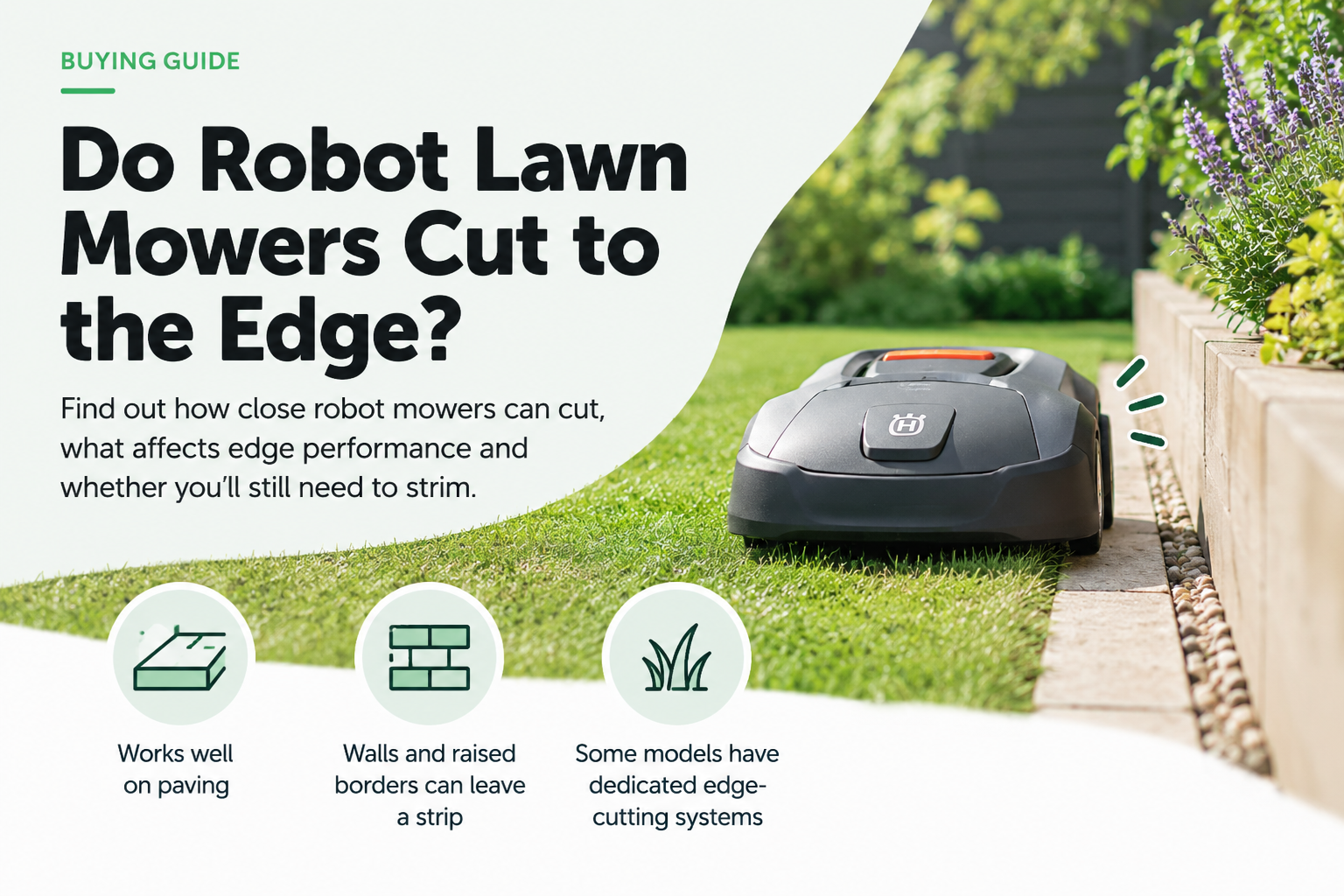
Robot lawn mowers can keep the main lawn consistently short, but the edge is where results vary. Some models leave a noticeable strip beside walls and raised borders, while others use offset or dedicated edge-cutting blades to get much closer.
The important point is that the mower is only half the equation. A flat paved edge is much easier to cut cleanly than grass finishing directly against a wall or raised flower bed.
The quick answer
Robot mowers can cut very close to the edge, but don’t assume that means zero strimming. Flat, level paving usually gives the best result because a suitable mower can overlap the edge. Walls, fences, raised borders and tight corners are more likely to leave a narrow strip of grass that needs occasional trimming.
In this guide
Why do robot mowers leave an uncut edge?
The blades sit underneath the mower body for safety. On a conventional design, this means the mower’s outer casing reaches a wall or raised border before the cutting disc can reach the grass immediately beside it.
This can leave a narrow perimeter of longer grass even when the rest of the lawn is perfectly maintained.
How noticeable that strip is depends mainly on two things: where the mower’s blades sit underneath the chassis and what type of boundary surrounds your lawn.
How do edge-cutting robot mowers work?
Manufacturers use different approaches, so “edge cutting” isn’t one standard feature.
Offset cutting disc
The main cutting disc is positioned closer to one side of the mower. This lets the blades reach nearer the perimeter while remaining safely underneath the body.
Separate edge-cutting disc
Some mowers add a smaller cutting disc specifically for the perimeter. The mower can therefore use its main blades for the lawn while the additional disc tackles grass closer to the edge.
Driving over the edge
Where grass meets level paving, a suitable mower can sometimes place part of its body over the hard surface. This lets the cutting system reach much closer to the end of the grass.
This last setup can make a surprisingly large difference.
Which garden edges give the best result?
Flat, mow-over borders are usually the easiest.
Imagine these two lawn edges:
Grass → level paving → patio
versus:
Grass → vertical brick wall
With the first, the mower may be able to overlap the paving. With the second, the wall physically stops the mower getting any closer.
If you’re landscaping the garden anyway, installing a row of level paving stones around difficult lawn edges can substantially reduce future trimming.
What about walls, fences and raised flower beds?
These are the boundaries most likely to leave some grass behind.
Common problem edges include:
- Brick or rendered walls
- Wooden fences directly beside the lawn
- Raised sleepers
- Kerbs
- Raised metal or plastic edging
- Sheds positioned directly beside the grass
An edge-cutting mower can reduce the remaining strip, but it cannot make its chassis pass through a solid obstacle.
This is why claims such as “reduces edge trimming” and “cuts to the edge” need to be considered alongside the layout of your own garden.
What about corners?
Tight internal corners are another difficult area. The mower needs enough room to position and turn its body before its blades can reach the grass.
A 90-degree corner where two raised borders meet may therefore need occasional manual attention even if the mower performs extremely well along straight edges.
Curved or open borders generally give the mower more room to manoeuvre.
Does wire-free navigation solve the problem?
Not by itself.
RTK, LiDAR or vision navigation may allow a mower to follow a virtual lawn boundary accurately, but navigation accuracy and blade reach are different things.
A mower can know exactly where a wall is while still being physically unable to cut the final strip of grass beside it.
When comparing models, check both the navigation system and the cutting-deck design.
Compare robot mower features
Compare lawn capacity, slopes, navigation, prices and ratings side by side before choosing a mower.
Will you still need to use a strimmer?
Possibly, but it may be much less often.
If most of your lawn meets flat paving and you choose a mower with effective edge cutting, manual edging could be minimal. If most of the perimeter consists of walls, fences and raised borders, expect some occasional finishing work.
Before buying, walk around your lawn and look at the perimeter rather than just the total lawn area.
A garden with 80 metres of flush paving presents a very different edging job from the same-sized lawn enclosed by 80 metres of raised brickwork.
What should you check before buying?
- Does the mower have a standard, offset or separate edge-cutting disc?
- How much of your lawn borders level paving?
- How much borders walls, fences or raised beds?
- Are there tight internal corners?
- Can the mower safely overlap your paved edges?
- Does the manufacturer promise zero trimming, or simply reduced trimming?
The practical answer
If avoiding strimming matters to you, don’t judge edge performance from the mower specification alone.
Look at the mower’s cutting-deck design and then walk around your own lawn. Flat mow-over borders give a robot mower the best chance of producing a finished edge; vertical obstacles are where some manual trimming is most likely to remain.
For some gardens, improving a few awkward borders can be just as valuable as choosing a mower with a dedicated edge-cutting feature.
Find the right robot mower for your garden
Use your lawn size, slopes and priorities to narrow down suitable models, or compare robot mowers side by side.